
Subotica’s Art Nouveau Landmarks: A Self-Guided Walking Route Through the Centre
Follow Subotica’s remarkable Secessionist architecture from Raichle Palace to the Synagogue, with City Hall, Korzo and Palić extensions along the way.
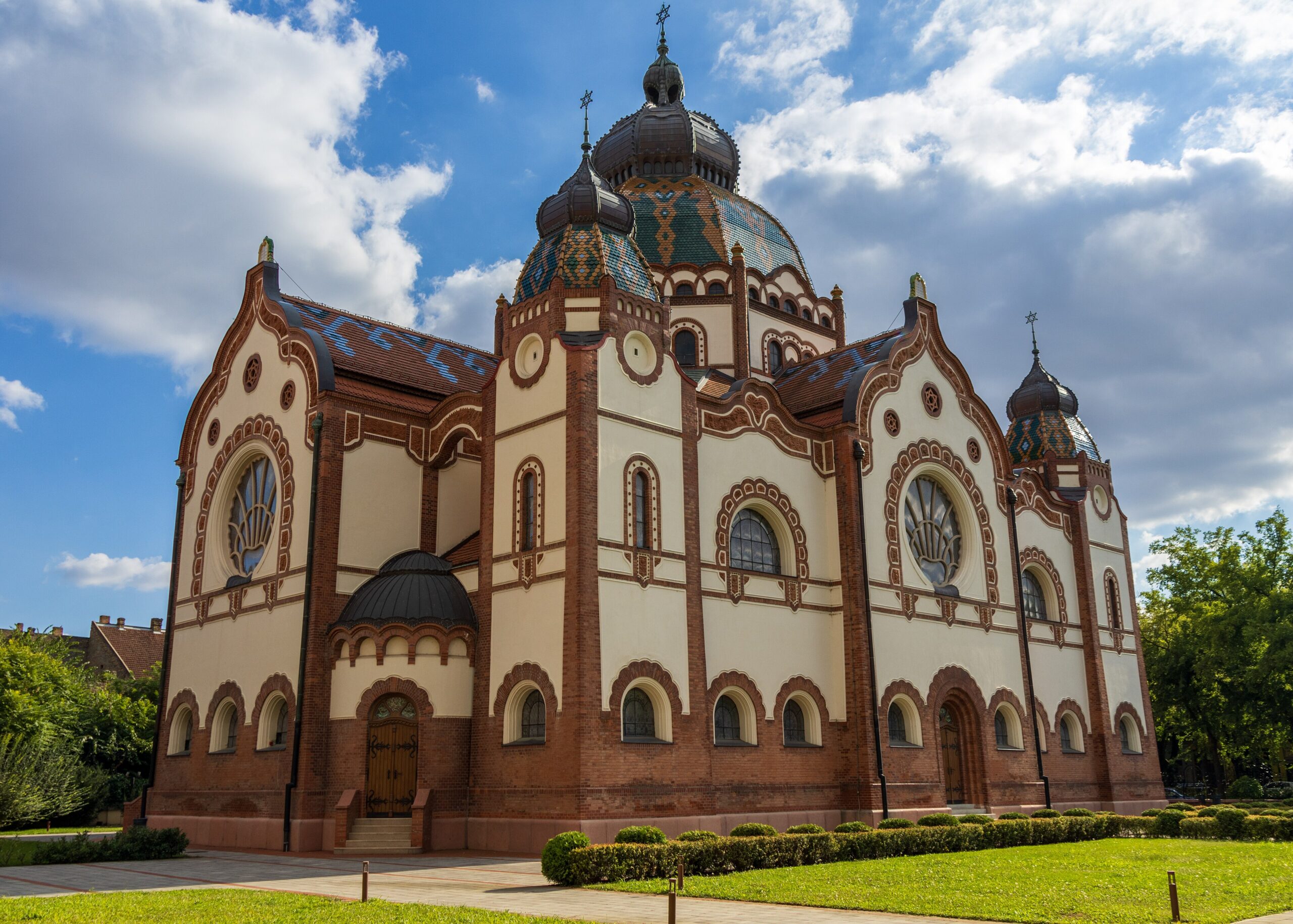
A Subotica Art Nouveau walking route reveals one of Serbia’s most distinctive urban landscapes. This northern city developed rapidly during the Austro-Hungarian era, and its centre still carries the confident, colourful character of that period. Ceramic flowers, stylised folk motifs, curving ironwork and vivid roof tiles turn an ordinary city walk into an architectural treasure hunt.
The route below follows a simple west-to-east line through the centre. It begins near the railway station at Raichle Palace, continues along Korzo to Republic Square, then finishes at the magnificent Subotica Synagogue. Allow time to look upwards. In Subotica, the best details often sit above shopfront level or around a doorway.
Why Subotica looks different
Subotica is closely associated with Hungarian Secession, the regional branch of Art Nouveau that flourished around the turn of the 20th century. Like Art Nouveau elsewhere in Europe, it favoured flowing lines and nature-inspired ornament. However, Hungarian Secession added a strong local identity through folk-art patterns, glazed ceramics and motifs drawn from the Carpathian Basin.
Architects Marcell Komor and Dezső Jakab played a defining role in the city’s appearance. Their work gave Subotica some of its greatest landmarks, most notably City Hall and the Synagogue. Their buildings do not treat decoration as an afterthought. Colour, structure and ornament work together, from grand towers to small tile panels.
This is also why Subotica suits an unhurried walking tour. The historic core is compact, yet the architecture rewards close attention. A single façade may combine folk-style flowers, geometric forms, stained glass and unusually shaped windows.
Route overview: from the station district to the Synagogue
This central route works well as a half-day architectural walk, although it can be shorter if you only admire the exteriors. Begin at Raichle Palace, near Subotica Railway Station, then walk along Korzo towards Trg Republike, or Republic Square. Here, City Hall and the National Theatre form the civic heart of the route.
From the square, continue through the central streets to the Synagogue on Jakab and Komor Square. The overall distance is manageable, but this should not be a rushed march. Pause for façade details, step into the square from different angles, and take time to view City Hall from across the open space.
- Beginning: Raichle Palace near the railway station
- Central stretch: Korzo and its commercial Secessionist façades
- Main square: City Hall, National Theatre and St. Michael’s Church
- Final landmark: Subotica Synagogue
Interior access is not guaranteed at any stop. In particular, check Synagogue visiting arrangements before your walk, and treat a City Hall tower visit as a welcome extra rather than the foundation of the day.
Stop 1: Raichle Palace and its exuberant façade
Raichle Palace provides an unforgettable opening to the walk. Designed in 1904 by architect Ferenc Raichle as a private residence, it feels more playful and personal than the great municipal buildings ahead. Its façade is full of movement, with floral decoration, coloured ceramic elements and curving lines that seem to resist symmetry.
Look closely at the entrance, roofline and window surrounds. The building has an almost storybook quality, yet it remains rooted in the architectural ideas of its time. Raichle used the decorative language of Secession to create a building that announced both artistic ambition and individual taste.
Raichle Palace also sets the right tone for Subotica. This is not a city where Art Nouveau survives only in one formal monument. The style appears in grand public buildings, private homes and commercial façades. From here, the route heads towards the centre along Korzo.
Stop 2: Follow Korzo and look above the shopfronts
Korzo is the central pedestrian route that links the station area with the main square. It is easy to walk through quickly, but it deserves a slower pace. The street shows how Secessionist taste shaped everyday urban life, not only monumental architecture.
As you walk, look for decorative plasterwork, curved gables, ornamental balconies and floral panels. Some façades are bold and colourful; others are more restrained. Together, they create a streetscape where the city’s early 20th-century confidence is still visible.
The nearby Subotica Railway Station makes a useful orientation point at the beginning or end of the walk, especially for visitors arriving by train. However, the architectural focus lies in the blocks between the station district and Republic Square. Keep moving eastward, and the skyline of City Hall soon becomes the route’s visual anchor.
Stop 3: City Hall, the great civic statement
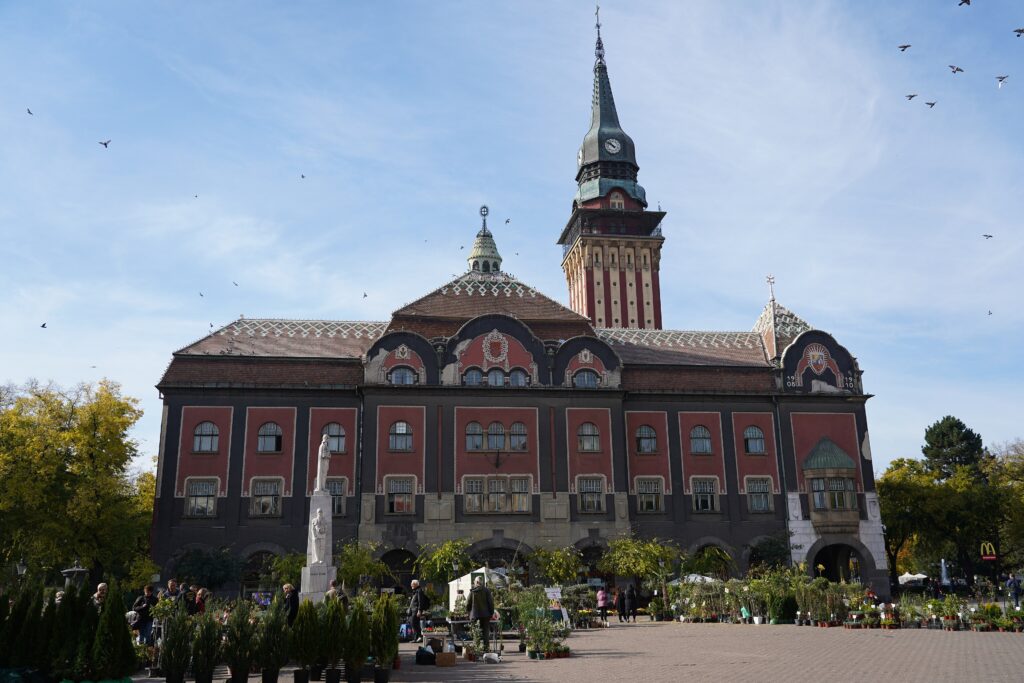
Subotica City Hall dominates Trg Republike and is the centrepiece of any architectural visit to the city. Completed in 1912 to designs by Komor and Jakab, it combines a huge civic scale with the decorative richness of Hungarian Secession.
Its tower is the obvious feature, rising above the square and giving the building a commanding presence. Yet the façade deserves equal attention. Notice the coloured ornament, folk-inspired patterns and varied surfaces. The building feels ceremonial without becoming severe, which is one reason it remains so memorable.
If access is available, the interiors can reveal another layer of the design, including decorative schemes that continue the building’s exterior language. Tower viewing may also be possible at certain times, but access can be limited. Plan your route around the exterior, then regard any interior visit as an addition.
Republic Square and the National Theatre
City Hall stands beside the Subotica National Theatre, another important stop on Republic Square. The theatre has a long and complex architectural history. Its present appearance reflects reconstruction and renewal, while the site itself remains tied to Subotica’s historic theatre tradition.
It offers a useful contrast with City Hall. City Hall is unmistakably a Secessionist declaration, while the theatre speaks more broadly about the changing civic life of the square. Stand back to take in the relationship between the two buildings, then cross the square for a different perspective on City Hall’s tower.
Also nearby is the Franciscan Church of St. Michael, an 18th-century church that predates the Art Nouveau boom. Its presence helps explain why Subotica feels layered rather than stylistically uniform. The church belongs to an earlier townscape, while City Hall expresses the optimism and artistic confidence of the early 1900s.
If you would like more historical background, the Subotica City Museum is close to the centre and can add context on the city’s multicultural past and built heritage. Exhibition access varies, so it is best approached as an optional cultural stop rather than a fixed part of the route.
Stop 4: The Subotica Synagogue, the route’s essential finale
The walk concludes at the Subotica Synagogue, the city’s outstanding Art Nouveau monument. Built in 1902–1903 by Marcell Komor and Dezső Jakab, it is one of the finest examples of Hungarian Secession anywhere in the region.
Even from outside, the building is extraordinary. Its dome, coloured tiles, floral motifs and intricate ornament create a rich visual rhythm. The decoration draws strongly on Hungarian folk forms, but it never feels merely decorative. Every detail contributes to a unified artistic vision.
The Synagogue is especially powerful because it combines architectural brilliance with cultural meaning. It recalls the important Jewish community that helped shape Subotica’s commercial and civic life. Visitors should treat the site with care and respect, whether viewing it from the square or entering when visiting arrangements permit.
If you can see the interior, pay attention to how light, colour and ornament work together. The building’s decorative scheme feels almost organic, as if flowers and branches have grown across its structure. Still, the exterior alone justifies the walk. This is the landmark that makes Subotica essential for travellers interested in Central European Art Nouveau.
What to notice along the way
Subotica’s architecture becomes more rewarding when you know what to look for. Hungarian Secession often moved away from strict classical symmetry. Instead, it embraced decorative asymmetry, soft curves and references to regional craft traditions.
- Floral motifs: tulip-like shapes, leaves and stylised blooms appear repeatedly.
- Coloured ceramics: glazed tiles bring deep greens, reds, blues and warm yellows to roofs and façades.
- Folk-art patterns: geometric and embroidered-looking details give buildings a regional character.
- Ironwork: balconies, gates and railings often use elegant curving lines.
- Rooflines: domes, gables and decorative chimneys can be as striking as the lower façades.
Photographers will find the best compositions by stepping away from the buildings rather than standing directly beneath them. Republic Square offers space for City Hall, while the area around the Synagogue allows its dome and façade to be seen more clearly.
Extend the Art Nouveau journey to Palić
Palić is not part of the central walking loop, but it makes a worthwhile separate extension for travellers with more time. This lakeside resort area lies outside central Subotica and has its own distinctive Secessionist heritage.
The most recognisable landmark is the Palić Water Tower, also designed by Komor and Jakab. Its decorative form provides a clear architectural link with Subotica City Hall and the Synagogue. It is a fitting next stop for anyone who wants to see how the same design ideas were applied beyond the city centre.
Nearby, the Palić Grand Terrace continues the resort’s early 20th-century atmosphere. The lakeside setting offers a different mood from the dense civic streets of Subotica. Consider Palić a separate outing rather than trying to squeeze it into the central walk.
A route built for looking closely
Subotica’s architectural riches are concentrated enough to explore on foot, yet varied enough to hold attention for hours. Raichle Palace introduces the imaginative side of Secession. Korzo reveals its presence in everyday city life. City Hall demonstrates its civic ambition, and the Synagogue brings the route to an unforgettable close.
Above all, this is a walk for travellers who enjoy details. Lift your eyes from the pavement, slow down at each façade, and let the colours and patterns guide you through one of the Balkans’ most remarkable Art Nouveau city centres.
Tours & experiences for Subotica
Popular experiences with current pricing and traveler ratings.
 Free cancellation
Private Transfer from Subotica to Belgrade Airport (BEG)
 Free cancellation
Private Queen of Art Nouveau in Subotica Tour

Subotica Private Walking Tour Experience
ToursToBalkans may earn a commission when you book through our partner links.