
Pula Arena: How to Visit Croatia’s Roman Amphitheatre
This Pula Arena visitor guide explains the amphitheatre’s Roman story, what to see inside, and how to extend your walk through ancient Pula.
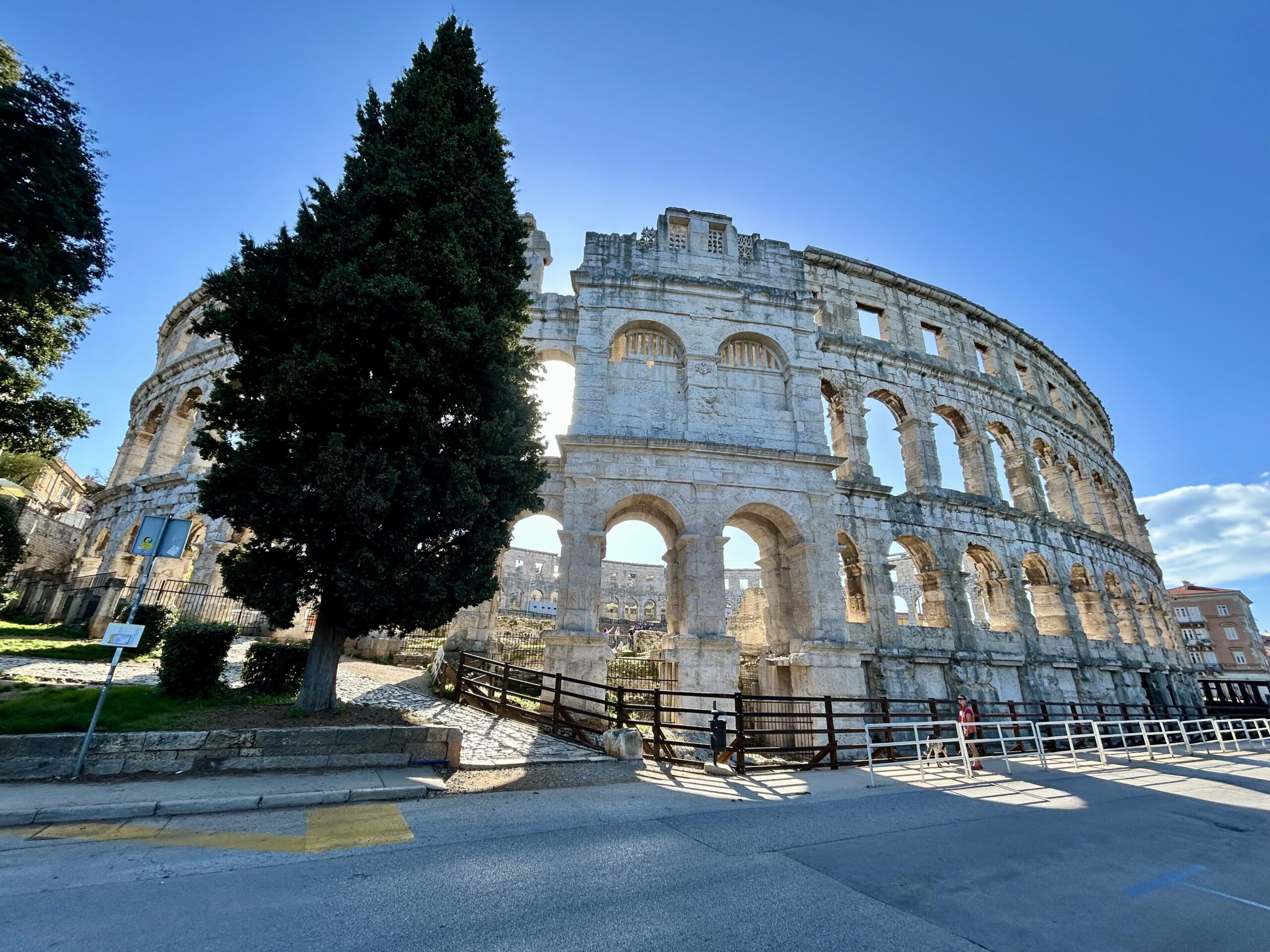
The Pula Arena visitor guide begins with a building that still defines the city’s skyline. Rising above the harbour-side streets, Pula Arena is one of the best-preserved Roman amphitheatres in the world. Its pale limestone walls, monumental arches and four surviving exterior towers make an immediate impression. Yet the real reward lies in understanding how this vast structure worked and how it connects to the Roman remains scattered through central Pula.
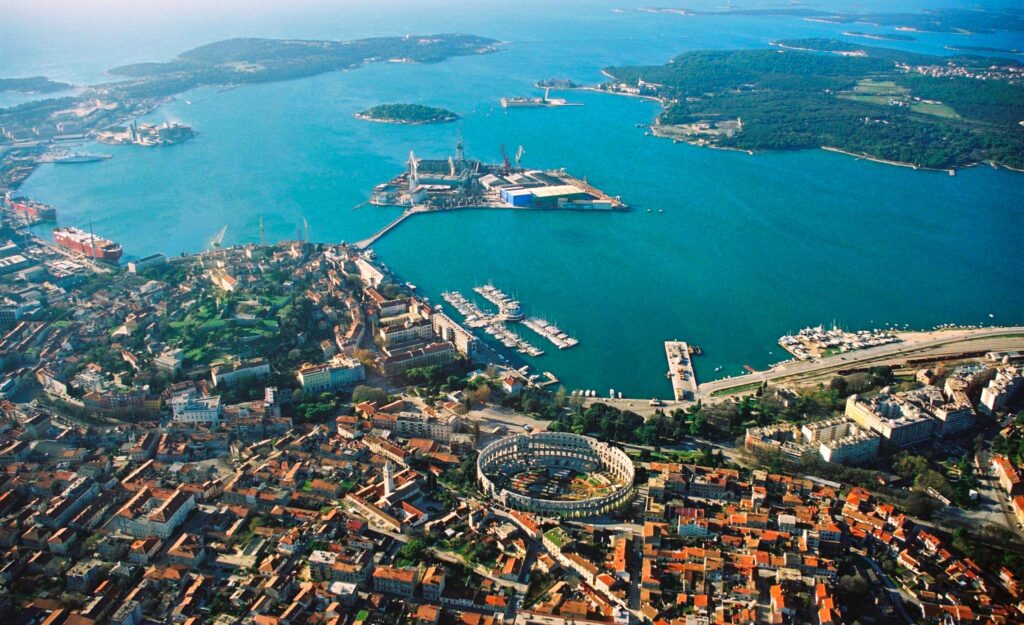
Why Pula Arena matters
Pula, known in Roman times as Pietas Julia, was an important settlement on the Adriatic. The amphitheatre was built in the 1st century AD, when public spectacles formed a major part of urban life across the Roman Empire.
Like other Roman arenas, it hosted events that drew large crowds. These included contests between gladiators, animal hunts and staged displays of power. It is best approached as a civic monument rather than simply a setting for violent entertainment. The Arena expressed Roman engineering, social hierarchy and the authority of the city itself.
What makes Pula exceptional is its survival. Much of the outer shell remains intact, including the full ring of arches and the four distinctive towers. Many ancient amphitheatres survive as partial ruins. Here, the scale and form of the building remain unusually clear.
A brief history of the Roman amphitheatre
The earliest version of the amphitheatre was probably more modest. It was enlarged in the 1st century AD, during the period when the Flavian dynasty ruled Rome. Emperor Vespasian is traditionally associated with its completion, although the building developed over time.
The Arena stood just beyond the ancient town, close to the harbour. That position made sense for a major public venue. It could receive visitors easily while remaining linked to Pula’s commercial and civic centre.
After the end of Roman rule, the building entered a long and complicated afterlife. It was used, adapted and at times quarried for stone. Its substantial preservation reflects later efforts to protect it, as well as the strength of its original construction.
What to see inside Pula Arena
The exterior walls and four towers
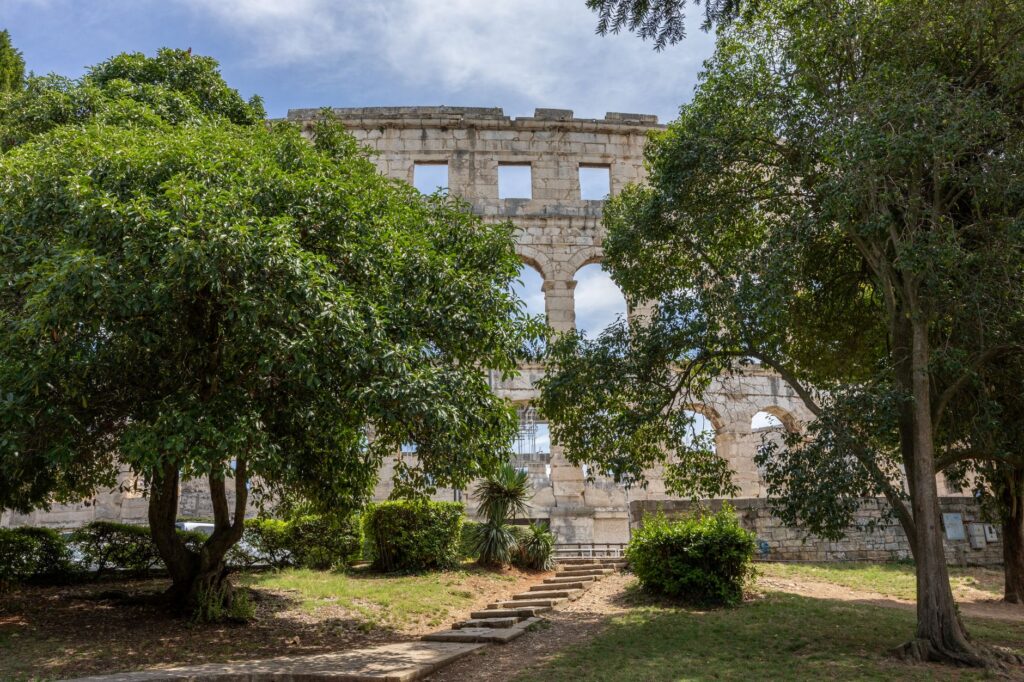
Before entering, walk around the outside of the Arena if time allows. The façade reveals the Roman preference for rhythm and proportion. Three levels of arches rise above the ground floor, while the uppermost level has rectangular openings rather than arches.
The four towers are especially important. They break up the oval exterior and give Pula Arena its recognisable silhouette. They were functional structures, not decorative additions, and formed part of the building’s sophisticated system for managing the venue.
From different angles, notice how the amphitheatre follows the slope of the land. Roman builders often worked with existing terrain, combining it with masonry vaults and retaining walls. In Pula, this produces a structure that feels both immense and surprisingly integrated into the city.
The arena floor and spectator views
Inside, the central arena makes the building’s scale easier to grasp. The seating has not survived in its original Roman form, but the oval plan remains vivid. Stand near the edge of the arena and look up at the surrounding walls. You can quickly imagine how spectators would have faced the action below.
The visit also reveals how carefully the Romans controlled movement. Entrances, corridors and stairways directed people to different parts of the structure. This was a highly organised public building, designed to handle a large audience with remarkable efficiency.
The Arena is still used for cultural events, so layouts and circulation can differ at times. When that happens, the best approach is to focus on the architecture that remains visible rather than expecting every viewpoint to be available.
The underground chambers
Do not overlook the subterranean spaces beneath the arena. These chambers offer the most revealing part of the visit because they shift attention from spectacle to infrastructure. Beneath the public arena lay service areas used to support the events above.
The underground displays explore olive oil and wine production in Roman Istria. This is a fitting theme for Pula, which stood within a productive Adriatic region linked to wider imperial trade routes. Amphorae, tools and interpretive material help show how agricultural goods moved from estates and workshops into Mediterranean commerce.
This section gives the Arena a broader context. Roman life was not only about emperors and entertainment. It also depended on farming, craft, shipping and trade. The exhibits make that everyday economic world easier to picture.
How to plan a satisfying Arena visit
Give the amphitheatre enough time to see both the exterior and the underground level. A quick photograph from outside captures its grandeur, but it misses the engineering and archaeological story that make the monument meaningful.
Morning or later in the day can offer gentler light for photography, especially around the outer arches. More importantly, walk beyond the main entrance areas. The view from the harbour side and the neighbouring streets shows how dramatically the Arena rises above modern Pula.
Wear comfortable shoes for stone surfaces and steps. Keep your plan flexible, too, as event preparations can affect the visitor route through the monument. The Arena sits close to Pula city centre, so it works naturally as the anchor for a short historical walk rather than an isolated stop.
Continue through Roman Pula on foot
From the Arena, central Pula unfolds easily on foot. The walk links a huge entertainment building with the smaller monuments of daily civic and commercial life. Together, they create a much fuller picture of the ancient town.
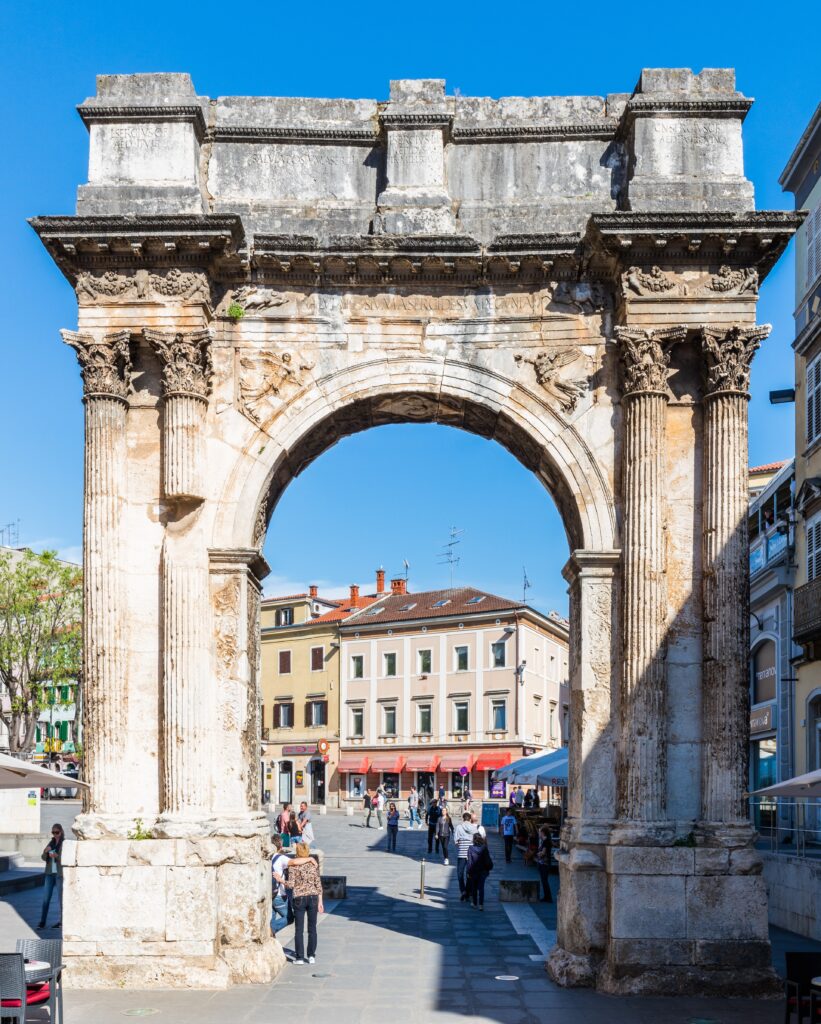
The Arch of the Sergii
The Arch of the Sergii stands near the entrance to the old town and dates to the late 1st century BC. Unlike a triumphal arch erected by an emperor, it was commissioned by a local family, the Sergii. Its relief decoration and elegant proportions show how local elites used Roman architecture to display status.
The arch also works as a visual gateway. Passing beneath it leads from the streets around the Arena towards Pula’s historic centre. It is an ideal reminder that Roman Pula was a lived-in town of homes, shops, public spaces and family ambition.
Pula Forum and the Temple of Augustus
Continue towards the Pula Forum, the ancient public square. This was the civic heart of Roman Pula, where political, religious and commercial life overlapped. It remains one of the city’s most atmospheric open spaces, framed by later buildings as well as Roman remains.
On the Forum’s western side stands the Temple of Augustus. Built during the Augustan era, it was dedicated to the imperial cult and remains one of the finest Roman temples in Croatia. Its compact façade, with Corinthian columns and a deep porch, offers a sharp contrast to the Arena’s massive scale.
Inside, the temple holds an archaeological collection. Even if you only admire it from the square, pause to study the proportions of the building. Its survival helps explain how deeply Roman civic and religious life shaped Pula.
Museums, fortifications and later layers of Pula
Roman Pula is the central story, but the city did not stop evolving after antiquity. The Archaeological Museum of Istria provides valuable context for the monuments, with material from prehistoric Istria and the Roman period. It is particularly worthwhile for travellers who want objects and excavated evidence to complement the architecture seen outdoors.
For a different historical layer, climb towards Pula Castle. The present fortress is Venetian in character, not Roman, and its hilltop position reflects Pula’s later strategic importance. The Historical Museum of Istria is associated with the castle, while the elevated setting offers broad views across the roofs, harbour and Arena.
If you have more time, Zerostrasse adds a 20th-century chapter to the walk. These underground passages were created as air-raid shelters and underline how often Pula’s strategic harbour has shaped its history. They are very different from the Roman underground chambers, but the contrast is part of the city’s appeal.
A landmark that makes sense of the city
Pula Arena is more than an impressive Roman survivor. It is the best place to understand the scale of ancient Pula and the ambition of the Roman Empire on the Adriatic. Its exterior towers and arches provide the spectacle; its underground spaces reveal the systems that sustained it.
Then walk to the Arch of the Sergii, the Forum and the Temple of Augustus. In a compact area, you move from amphitheatre to street monument to civic square. That sequence turns a visit to Pula Arena into a clear, memorable journey through Roman urban life.
Tours & experiences for Pula
Popular experiences with current pricing and traveler ratings.
 Free cancellation
Pula: Night Kayak Tour with Glowing Kayaks
 Free cancellation
Dolphin Watching & Sunset Boat Tour With Drinks & optional Dinner
 Free cancellation
Pula: Cave Kayak Tour and Snorkeling
 Free cancellation
Medulin-Kamenjak 5h boat trip ALL-INCLUSIVE drinks on Sandra Boat
 Free cancellation
Brijuni National Park Dolphin Sunset Tour | DINNER & DRINKS
 Free cancellation
Istrian Olive Oil Guided Tasting in Pula
ToursToBalkans may earn a commission when you book through our partner links.


