
Gjirokastër Castle: What to See Inside Albania’s Hilltop Fortress
Explore Gjirokastër Castle’s museums, prison cells, aircraft, clock tower and valley views, with context for visiting Albania’s most dramatic fortress.
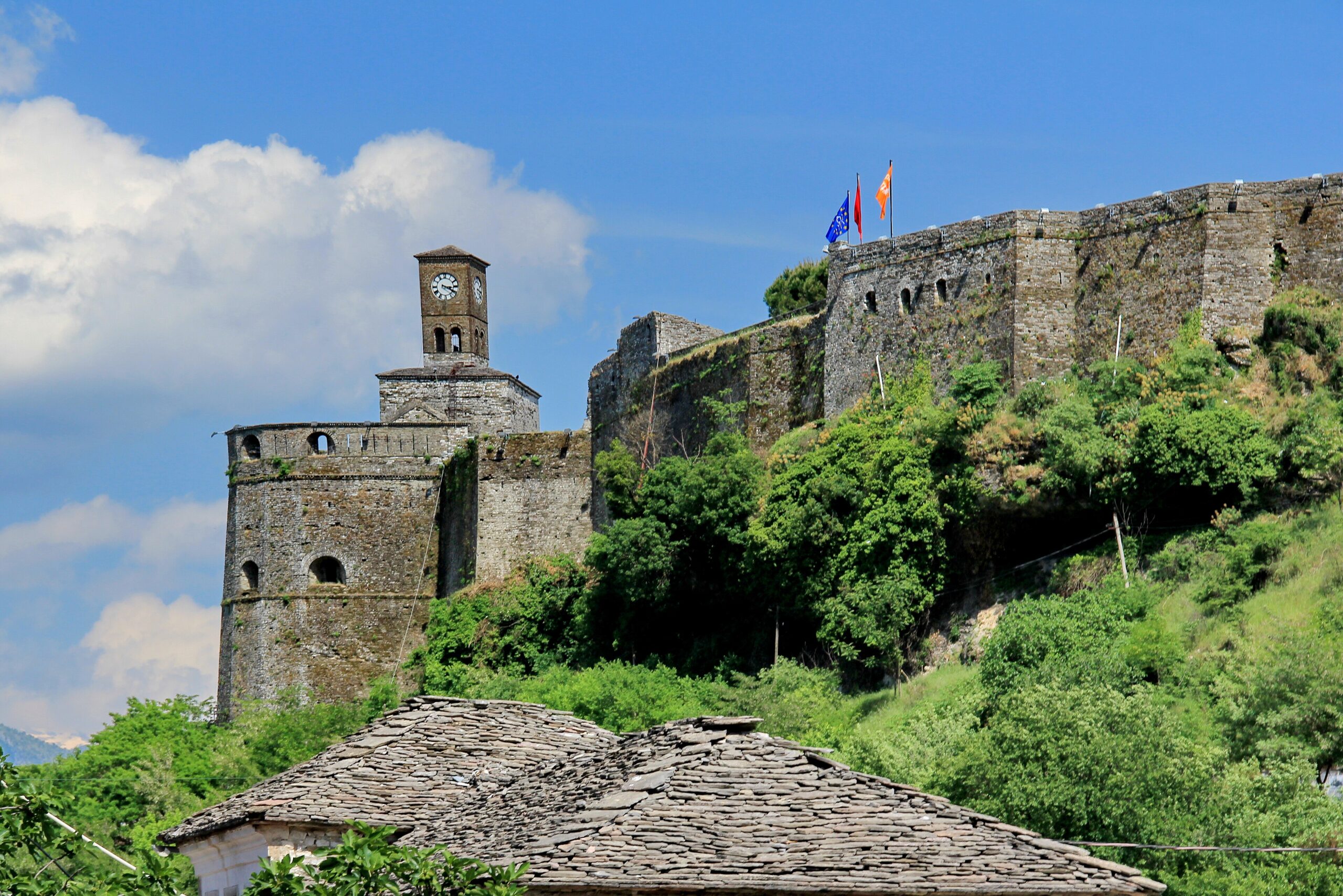
A Gjirokaster Castle visitor guide should begin with the setting. This vast stone fortress rises above the steep roofs of Gjirokastër’s historic centre, commanding the Drino Valley from a long, rocky ridge. It is not simply a monument to admire from below. Inside, the castle becomes a sequence of gates, ramparts, museum rooms, prison cells, broad courtyards and striking views.
The fortress is the defining landmark of UNESCO-listed Gjirokastër. Its walls help explain why the city developed where it did, while its later additions reveal changing Albanian history through Ottoman rule, twentieth-century conflict and the communist era. Allow time to wander rather than treating it as a quick viewpoint.
Continue planning with Best Gjirokaster Tours & Experiences.
Why Gjirokastër Castle matters
Gjirokastër Castle dominates both the skyline and the visitor experience of the city. From the Old Bazaar below, its heavy walls appear almost fused with the hillside. The climb towards the entrance also shows the relationship between the fortified citadel and the stone-built town beneath it.
Although the castle has medieval roots, much of its present appearance comes from later rebuilding and expansion. Ottoman rulers strengthened it, adapted its defences and used it as a military base. The result is a fortress with a long, irregular shape, designed to follow the ridge rather than conform to a neat geometric plan.
This scale is one reason the visit is so rewarding. Some Balkan castles offer a compact keep and a short circuit of walls. Gjirokastër feels more like a small fortified district. You pass through vaulted passages, open defensive spaces and enclosed rooms with different purposes and moods.
A viewpoint over the Drino Valley
The terraces and ramparts offer the castle’s most immediate reward: wide views across the Drino Valley. Look down towards Gjirokastër’s slate-grey roofs, then beyond the town towards the mountains and open valley floor. From this height, the castle’s defensive position becomes obvious.
The views also give a better sense of the historic centre’s layout. Gjirokastër’s distinctive houses spread down the slopes in layers, with the Old Bazaar forming a natural link between the fortress and the lower town. Bring sturdy footwear, as the surfaces are often steep, uneven and worn smooth by time.
A short history of the fortress
Gjirokastër Castle stands on earlier fortifications, but the structure visitors see today reflects several major building phases. Its strategic location made it valuable to whoever controlled the valley route. Over centuries, the citadel changed hands and evolved from a defensive stronghold into an administrative and military complex.
The Ottoman period left the strongest mark. In the early nineteenth century, Ali Pasha of Tepelena expanded and reinforced the castle during his powerful rule over much of southern Albania and neighbouring territories. His building campaigns gave the fortress much of its formidable scale, including strengthened walls and spaces suited to artillery-era warfare.
That history matters because it explains the castle’s character. This is not an elegant palace created for ceremonial display. It is a working stronghold, shaped by military needs. Narrow entrances, thick stone vaults, firing positions and elevated terraces all reflect a site built to control a strategic landscape.
The castle continued to serve military and state functions in the twentieth century. Its prison spaces, weapons displays and aircraft preserve traces of those later chapters. Visitors therefore move through several periods at once: medieval foundations, Ottoman expansion, wartime memory and communist-era repression.
What to see inside Gjirokastër Castle
Gjirokastër Museum
Within the castle complex, Gjirokastër Museum provides the clearest introduction to the city and fortress. Its displays place the citadel in a wider civic story, exploring Gjirokastër’s development, local identity and military past. Visit it early if you want the walls and towers outside to feel less anonymous.
The museum is especially useful for travellers who know Gjirokastër mainly for its Ottoman-era houses. Those houses are central to the historic town, yet the castle reveals the political and defensive power behind the settlement. Together, they show two sides of the city: domestic life below and authority on the ridge above.
Take your time with the interpretive material rather than rushing through on the way to the ramparts. The fortress is large, and a little historical grounding makes the rest of the circuit more meaningful.
The National Museum of Armaments
The National Museum of Armaments occupies former prison spaces within the castle. This is one of the most atmospheric parts of the visit, because the setting is as important as the objects on display. Thick walls, confined cells and vaulted interiors create a stark contrast with the open valley views outside.
The museum includes weapons and military material from different periods, but it also brings the castle’s prison history into focus. Under communist rule, the fortress served as a place of detention. That association gives the rooms a heavier emotional tone than the more expansive areas of the citadel.
It is worth treating the prison and armaments section as a distinct stop, not as a simple extension of the general city museum. The two spaces answer different questions. One explains the fortress and Gjirokastër as a whole; the other confronts the site’s military role and its difficult twentieth-century legacy.
The aircraft: an unusual Cold War-era landmark
Few European castles have a military aircraft displayed within their walls. At Gjirokastër Castle, the aircraft has become one of the most photographed objects in the grounds. Its metal body looks startling against the pale stone ramparts and mountain landscape.
The plane is commonly linked with Cold War history, and several stories circulate about how it came to be in Albania. These accounts vary, and the aircraft’s exact origin remains disputed. It is best appreciated as a powerful symbol of Albania’s isolated twentieth-century past rather than as a tale with one settled version.
Its presence also underlines how the castle never became a frozen medieval relic. The fortress continued to gather new meanings long after its Ottoman military peak. A Cold War-era aircraft, prison cells and weapons galleries sit within walls that began life in a much older defensive world.
Clock tower, festival stage and the walk along the walls
Find the clock tower as you explore
The Clock Tower is one of Gjirokastër Castle’s most recognisable features. This Ottoman-period landmark rises above the fortress skyline and serves as a helpful point of orientation as you move through the grounds. It is particularly striking from the terraces, where its vertical form breaks up the long horizontal line of the walls.
Rather than searching for a single perfect viewing angle, notice how the tower appears and disappears during the walk. From some parts of the castle it feels like a distant landmark; from others, it becomes part of the immediate architecture overhead.
A fortress that still hosts public culture
The open-air festival stage is another reminder that the castle remains part of Gjirokastër’s public life. Built for folklore performances, it occupies a broad space within the grounds and gives the fortress an unexpectedly civic character. Even when no event is taking place, the stage helps visitors imagine the castle as a gathering place, not only a military monument.
Do not plan a visit around a particular performance unless you have confirmed local details independently. The lasting attraction is the setting itself: an expansive stone venue enclosed by fortress walls, with the valley opening beyond.
As you continue along the outer areas, pause wherever the walls open towards the Drino Valley. These quieter stretches often provide the strongest sense of the castle’s scale. The defensive architecture becomes easier to read when you can see the steep slopes, distant routes and wide valley that it once protected.
How to visit thoughtfully
Gjirokastër Castle works best as the central experience of a half-day in the historic town. The Old Bazaar below the hill is the natural companion. Its cobbled lanes, stone façades and small squares provide a gentler counterpoint to the fortress’s massive walls.
You can walk between the bazaar and the castle, but expect gradients. The uphill approach is part of the experience, since it reveals the citadel’s commanding position. Wear shoes with reliable grip and take care on uneven stone steps, especially in enclosed passages and exposed rampart areas.
Interior access can vary between rooms and sections, so regard the museums, prison cells and outdoor circuit as the main framework rather than a rigid checklist. The castle rewards curiosity. Look into side passages, study the construction of the arches and notice the changes between older masonry and later defensive additions.
Extend the story beyond the walls
Ali Pasha’s Aqueduct offers a worthwhile extension for travellers interested in the fortress’s wider infrastructure. Built in the early nineteenth century to supply the castle with water, its surviving arches lie outside the citadel and require a separate walk. It should not be treated as an attraction inside the castle grounds.
The remains are fragmentary, yet they add an important detail to the story of the fortress. A hilltop stronghold needed more than thick walls. It also required dependable water, supplies and connections to the surrounding landscape. The aqueduct makes that practical reality visible.
For a fuller Gjirokastër day, return to the Old Bazaar after the castle visit. The descent brings you back into the everyday scale of the historic town, where houses, lanes and workshops sit in the fortress’s shadow. That contrast is the essence of Gjirokastër: a lived-in stone city watched over by one of Albania’s most memorable citadels.
What makes the castle unmissable
Gjirokastër Castle is more than a viewpoint and more than a museum complex. It is the place where the city’s history becomes tangible. Ottoman-era ramparts meet prison cells, military collections and a Cold War-era aircraft, while the Drino Valley spreads out beyond the walls.
Give the fortress enough time to reveal its layers. Walk the terraces, visit the museum rooms, pause by the clock tower and look down towards the Old Bazaar. By the time you leave, Gjirokastër’s dramatic setting will make complete sense.
Tours & experiences for Gjirokaster
Popular experiences with current pricing and traveler ratings.
 Free cancellation
Vegetarian Cooking Class @Teta Marjeta
 Free cancellation
Amazing Horse Riding Experience at Vjosa National Park in Permet
 Free cancellation
From Tirana / Durres : Permet / Thermal Baths & Canyons Day Tour
 Free cancellation
River Tubing Experience at Vjosa National Park in Permet, Albania
 Free cancellation
Prepare Osa with Teta Marjeta
 Free cancellation
Private Cold War City Tour in Gjirokaster
ToursToBalkans may earn a commission when you book through our partner links.
Best places in Gjirokaster
Selected attractions and places to eat with Tripadvisor data, curated for a cleaner trip-planning experience.
Top restaurants in Gjirokaster


Recommended hotels in Gjirokaster
Selected well-rated hotels with Agoda booking links.

Current rates and availability are confirmed on Agoda.