
Diocletian’s Palace: What to See and Know
Discover Split’s remarkable Roman core, from the Peristyle and cathedral to imperial cellars, ancient gates, and the waterfront façade.
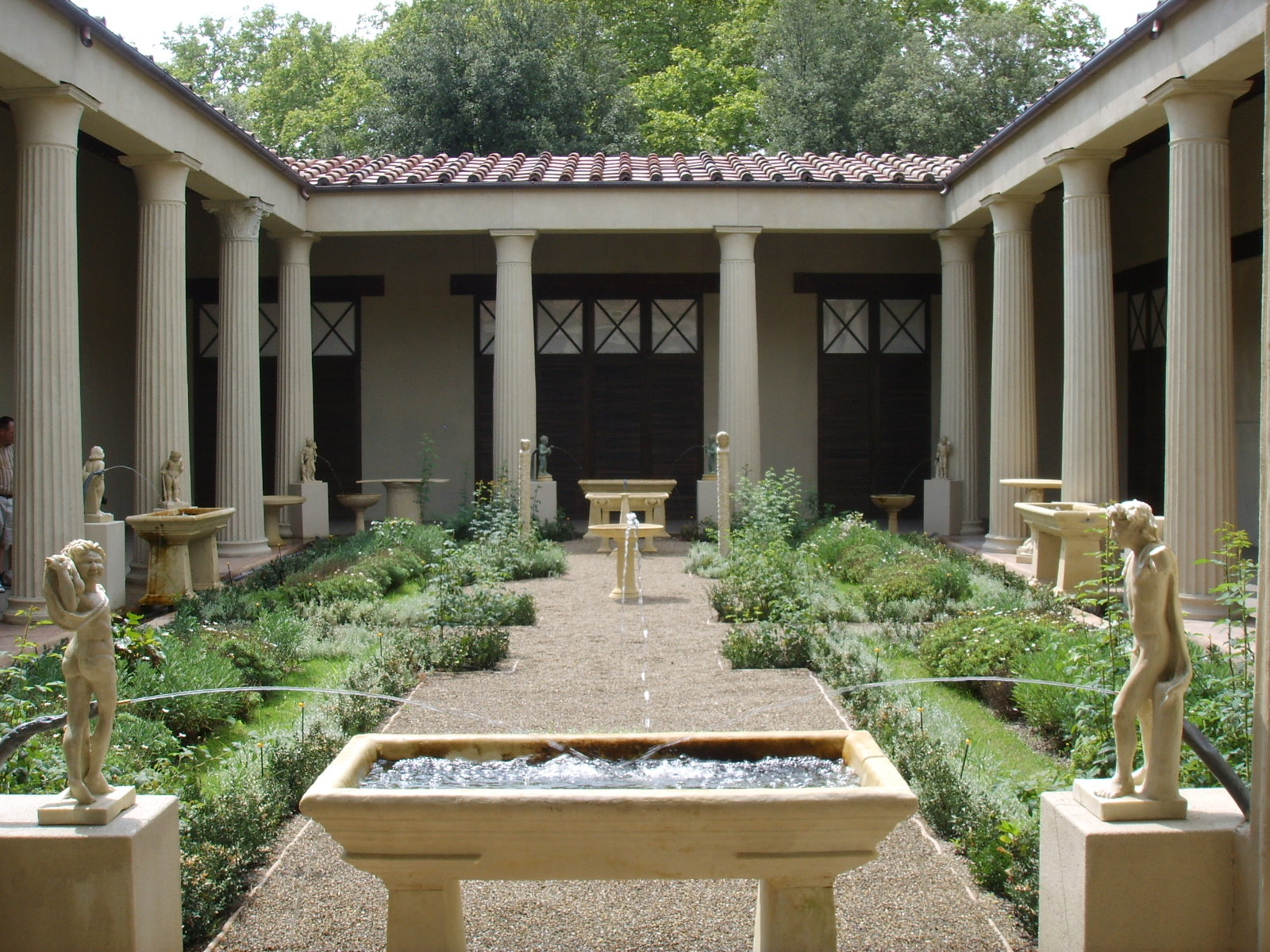
Diocletian’s Palace is not a conventional palace museum or a sealed archaeological site. It is the living historic core of Split, where Roman walls contain homes, cafés, churches, lanes, and busy squares. For a first visit, understanding its original plan makes every column, gate, and worn stone passage far more meaningful.
Built for Emperor Diocletian in the early 4th century, the vast complex stood on the Adriatic shore near the Roman city of Salona. It combined an imperial residence, a military-style fortified enclosure, ceremonial spaces, temples, and service quarters. After the Roman world changed, people adapted the palace rather than abandoning it. That long process created the extraordinary Split Old Town seen today.
Continue planning with Best Split Tours & Experiences and Where to Stay in Split: Best Areas for Visitors.
Understand the palace before you explore
Diocletian chose this site for his retirement residence after ruling the Roman Empire. The complex had a clear Roman layout. High walls enclosed a near-rectangular area, with grand gates on the landward sides and a sea-facing southern façade.
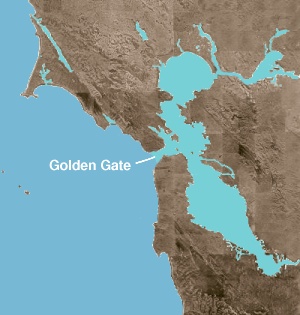
The northern half held barracks, stores, and service areas. The southern half was more private and ceremonial, with Diocletian’s apartments overlooking the sea. A central north-to-south route led from the Golden Gate toward the Peristyle, the palace’s formal heart.
Much of the palace above ground has changed over the centuries. Medieval houses, churches, and later façades occupy former Roman rooms. Yet the essential framework remains strikingly legible. Look for massive masonry, ancient columns, monumental archways, and the tight relationship between the old walls and modern city life.
A palace transformed into the heart of Split
The story of Diocletian’s Palace is also the story of Split. In late antiquity, refugees from nearby Salona sought safety within its strong walls. They turned imperial spaces into homes, workshops, and religious buildings.
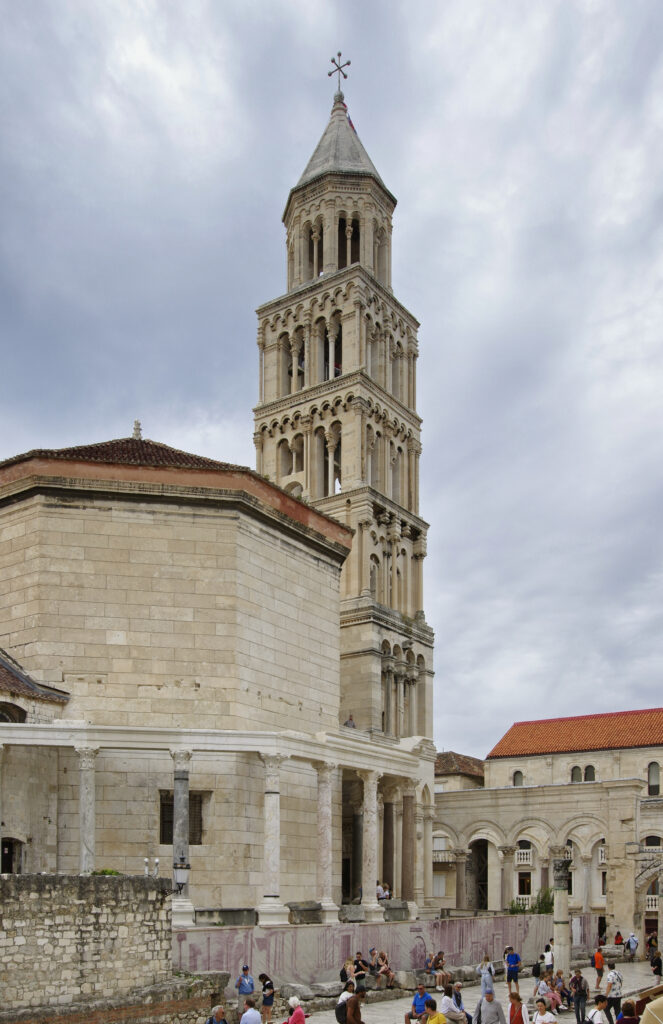
One of the most powerful transformations was Diocletian’s own mausoleum. The emperor had been associated with persecution of Christians, but his burial building later became the Cathedral of Saint Domnius, named for a Christian martyr linked to Salona.
Medieval Split continued to build within and beyond the Roman enclosure. Under Venetian influence, the city gained new civic and commercial character, especially on its western edge. The result is not a pure Roman monument. It is a compact record of Roman, early Christian, medieval, Venetian-era, and modern urban life.
This layered history helped earn the historic complex UNESCO World Heritage status. Still, its greatest appeal is immediate: the palace remains a real neighbourhood, not simply a monument viewed from behind barriers.
The Peristyle: the ceremonial centre
The Peristyle is the best place to grasp the imperial scale of Diocletian’s Palace. This colonnaded courtyard formed the grand approach to the emperor’s apartments. Tall columns frame the space, while the elevated entrance at its southern end gave the ruler a suitably theatrical setting for public appearances.
Ancient Egyptian sphinxes once added further prestige to the court. One remains by the steps, offering a vivid reminder that Roman power drew on the visual language of the wider Mediterranean world.
Today, the Peristyle is enclosed by two of the palace’s most important sacred buildings. The former mausoleum rises on one side, while the Temple of Jupiter lies close by. Stand in the centre and notice how the Roman architecture directs your view upward and inward. The space still feels formal, even with daily life moving through it.
The Cathedral of Saint Domnius
The Cathedral of Saint Domnius began as Diocletian’s mausoleum. Its substantial circular form and surrounding columns are Roman, while its Christian identity reflects the city’s later history. This reversal gives the building unusual emotional force: an imperial tomb became a cathedral serving the community that grew inside the palace walls.
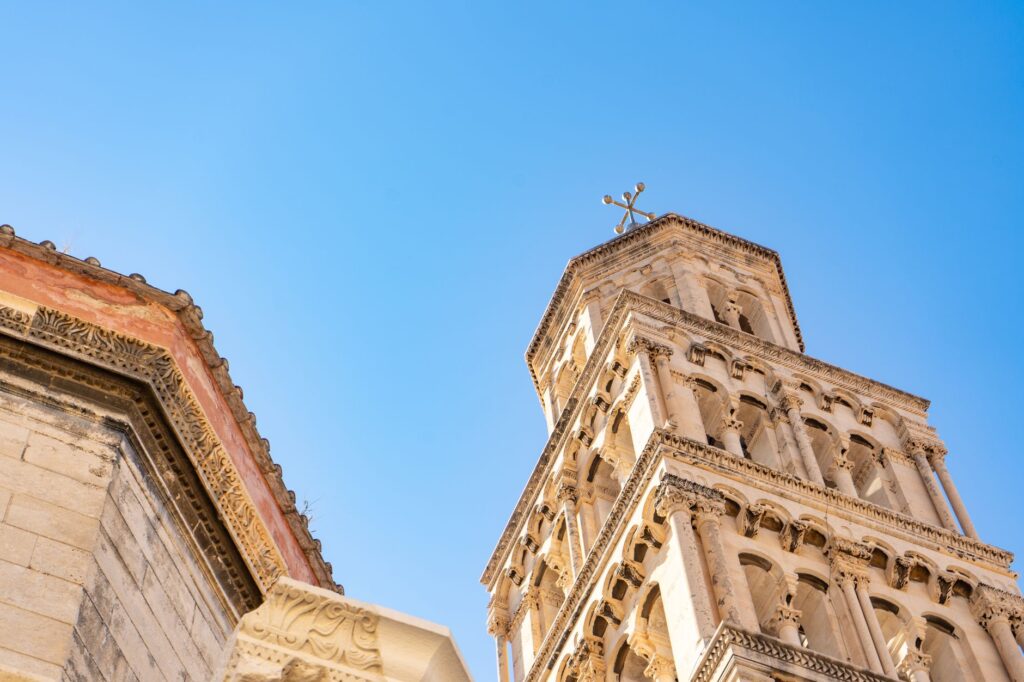
The Romanesque bell tower is a much later addition and has become one of Split’s defining landmarks. Its vertical silhouette contrasts with the low, fortress-like geometry of the Roman core. From outside, take time to study the transition between the ancient mausoleum and the medieval tower rather than treating them as one period.
As this is an active religious space, visitors should enter respectfully. Access to interiors and monuments can vary, so it is sensible to remain flexible about what you see inside.
The Temple of Jupiter
A short walk west of the Peristyle brings you to the Temple of Jupiter. It is compact, but it preserves one of the clearest surviving sacred interiors within the palace. The temple originally served the imperial cult, which linked the emperor’s authority to the Roman religious order.
Later, the building became a baptistery. That conversion echoes the cathedral’s story and shows how thoroughly the palace was reimagined after antiquity. Outside stands another Egyptian sphinx, though time has visibly altered it. The small scale of the temple makes its carved stonework and deep entrance particularly memorable.
Follow the route to the emperor’s quarters
From the Peristyle, continue south through the Vestibule. This circular chamber once marked the threshold between the public ceremonial court and the emperor’s more private apartments. Its open upper section and domed form create a dramatic sense of height.
Pause briefly inside. Sound carries unusually well in the enclosed stone space, making the Vestibule feel distinct from the bright, open Peristyle. It is a fine example of Roman architecture shaping movement and atmosphere, not merely providing decoration.
The basements reveal the lost palace above
The Basements of Diocletian’s Palace are essential because they preserve the ground plan of rooms that once stood above them. The imperial apartments on the southern side have largely disappeared or been altered, but the substructures below retain their broad halls, vaults, passages, and divisions.
Walking through them gives a clearer sense of the residence’s former size. These were not simply dark cellars. They supported the imperial level above and followed much of its arrangement. Their stone vaulting is among the strongest surviving expressions of the palace’s Roman engineering.
The basement routes also lead naturally toward the waterfront. This is an effective way to connect the inward-looking palace complex with its original relationship to the Adriatic.
The Riva and the southern façade
Step out onto the Riva, Split’s long waterfront promenade, and turn back toward the old city. You are looking at the palace’s southern side, which once faced the sea. This was the more private imperial façade, with apartments above and service spaces below.
Its appearance has changed through later building and renovation, yet the Roman structure still shapes the scene. Look for the rhythm of arches and openings within the layered façades. From the waterfront, it becomes clear that the palace was designed as both a defended enclosure and a residence with a privileged maritime outlook.
See the gates and the fortified walls
The four principal gates offer another way to read the palace. They were once controlled points of entry through the defensive walls. Each has developed a different character as Split expanded around and through the Roman enclosure.
Golden Gate
The Golden Gate, on the north side, was the grandest landward entrance. It gives the strongest impression of the palace as a fortified imperial complex. Its scale, niches, and heavy masonry suggest the authority Diocletian wanted visitors to feel before they entered.
Nearby stands the large statue of Gregory of Nin, a later monument and a familiar city landmark. The contrast is telling: Roman architecture, medieval religious memory, and modern civic identity all meet at this edge of the old town.
Silver Gate and Iron Gate
The Silver Gate lies on the eastern side, close to the market area known as Pazar. It offers a natural route between the palace and the active streets beyond its walls. Although altered over time, it still helps reveal the original Roman perimeter.
On the western side, the Iron Gate shows even more clearly how later life settled into ancient architecture. An early medieval church was incorporated above the passage, turning a Roman entrance into a layered urban threshold. This is one of the best reminders that not every visible element in the palace is Roman, even when it sits within Roman walls.
Beyond the walls: Pjaca and medieval Split
Just beyond the western edge of the palace, People’s Square, or Pjaca, opens into a different chapter of Split’s history. The square developed as the city grew outside the original enclosure. Its façades and civic character reflect the medieval and Venetian-era city more than Diocletian’s residence.
That contrast is worth seeking out. Within a few minutes, you can move from late Roman military architecture to a more open civic square shaped by trade, local government, and later architectural styles. Split makes most sense when viewed as a city built through the palace, then beyond it.
How to make your visit more rewarding
- Walk with the Roman plan in mind. Enter through a gate, find the Peristyle, continue through the Vestibule, and descend toward the basements and Riva.
- Look above street level. Ancient capitals, arches, wall sections, and reused stone often appear above shops and doorways.
- Distinguish periods. Roman columns and walls stand beside medieval churches, Venetian-influenced façades, and later houses.
- Respect the setting. The palace contains homes, businesses, and active religious spaces. It remains part of everyday Split.
- Allow time to wander. The principal monuments matter, but quiet lanes between them often reveal the palace’s most intimate details.
Diocletian’s Palace rewards curiosity more than a checklist. See the Peristyle, cathedral, Temple of Jupiter, basements, gates, and Riva, then let the smaller passages explain the rest. Few places in Europe make the passage from Roman imperial power to modern city life feel so immediate.
Tours & experiences for Split
Popular experiences with current pricing and traveler ratings.
 Free cancellation
Blue Cave and Hvar Tour - 5 Islands Tour from Split and Trogir
 Free cancellation
Split Tuk Tuk Tour – Diocletian’s Palace & City Highlights
 Free cancellation
Blue Cave, Mamma Mia and Hvar, 5 Islands Speed boat Small group
 Free cancellation
Blue Lagoon & 3 Islands Small-Group Speedboat Tour
 Free cancellation
From Split: Krka Waterfalls, Food & Wine Tasting Tour
 Free cancellation
Blue Lagoon & 3 Islands Cruise with Lunch, Wine & Swim from Split
ToursToBalkans may earn a commission when you book through our partner links.


