
Sarajevo Old Town Guide: Baščaršija, Food & History
Explore Sarajevo Old Town through its Ottoman bazaar, landmark mosques, living crafts, layered religious heritage and essential Bosnian food traditions.
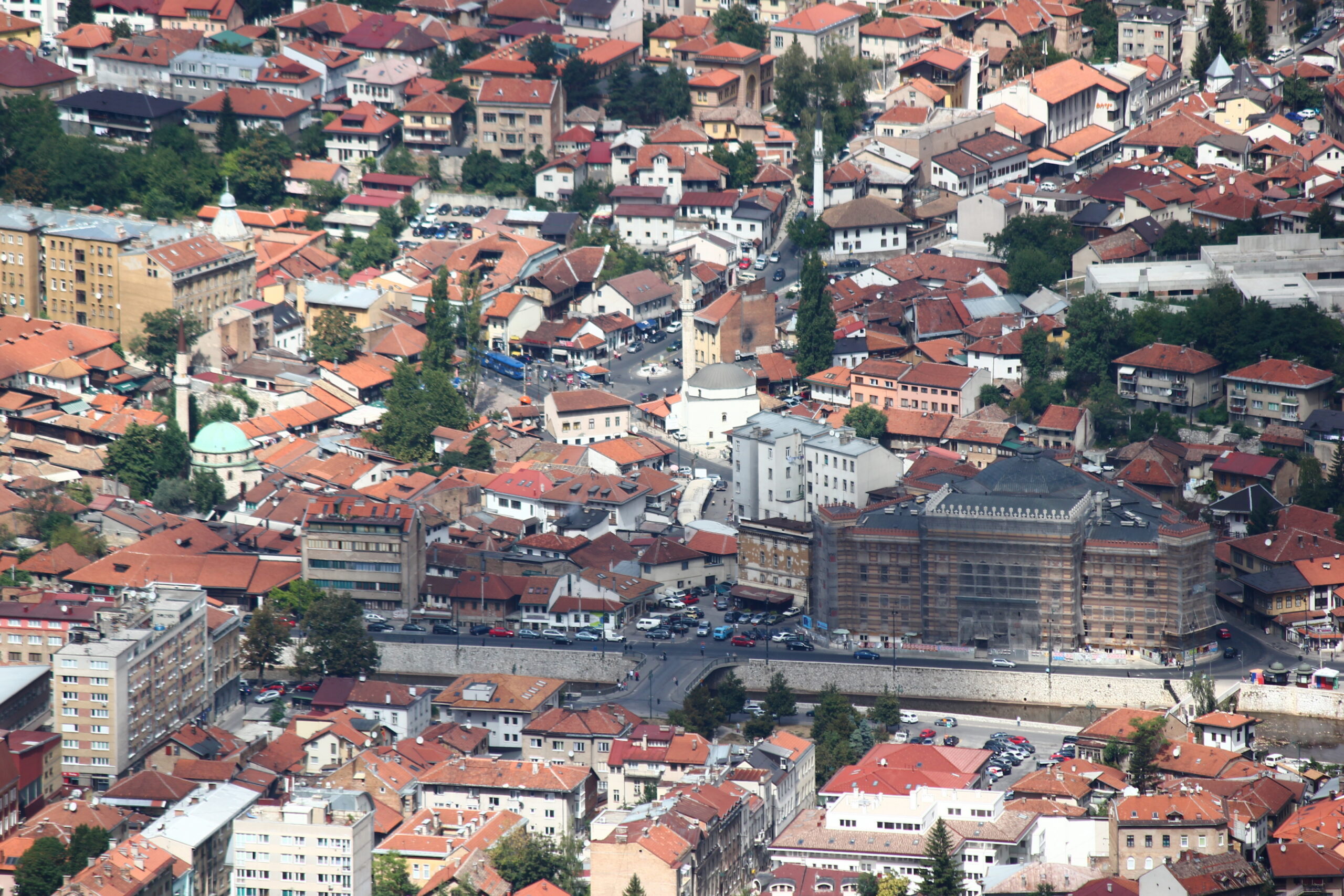
The sarajevo old town is a compact, richly layered place where an Ottoman bazaar meets Austro-Hungarian avenues, and where Muslim, Orthodox, Catholic and Jewish heritage lies within an easy walk. Its heart is Baščaršija, a historic commercial quarter of narrow lanes, copper workshops, mosques, markets and coffee houses beside the Miljacka River.
This is not an old town preserved behind ropes. Baščaršija remains part of daily Sarajevo life. Walk slowly, look into courtyards, and allow time for a coffee or a simple meal. In half a day, you can follow Sarajevo’s story from its Ottoman foundations to the assassination of 1914 and the city’s more recent, painful history.
Continue planning with Best Restaurants in Sarajevo: What to Eat and Best Sarajevo Tours & Experiences.
What counts as Sarajevo Old Town?
Baščaršija is the historic core most visitors mean when they speak of Sarajevo Old Town. It developed under Ottoman rule as a market district, with trades grouped in dedicated streets and public buildings funded through charitable endowments. Although fires repeatedly damaged the quarter, its street pattern and commercial spirit survived.
The area is centered on Baščaršija Square and then stretches west towards Ferhadija, the main pedestrian street. This route makes Sarajevo’s changing architectural language easy to see. Low Ottoman-era buildings, tiled roofs and inward-looking courtyards gradually give way to the grander façades of the Austro-Hungarian period.
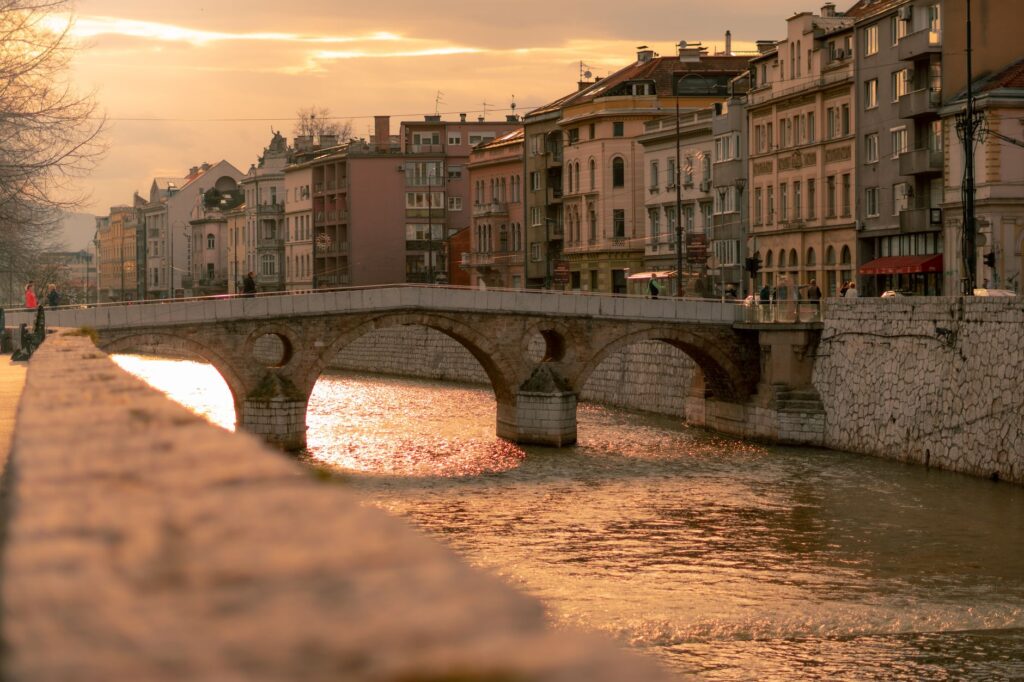
The Miljacka forms the southern edge of much of the old centre. Its bridges are more than practical crossings: they connect the bazaar with key moments in Sarajevo’s history, including the events of 1914 near Latin Bridge.
Baščaršija: an Ottoman market quarter still in use
Sebilj and the square
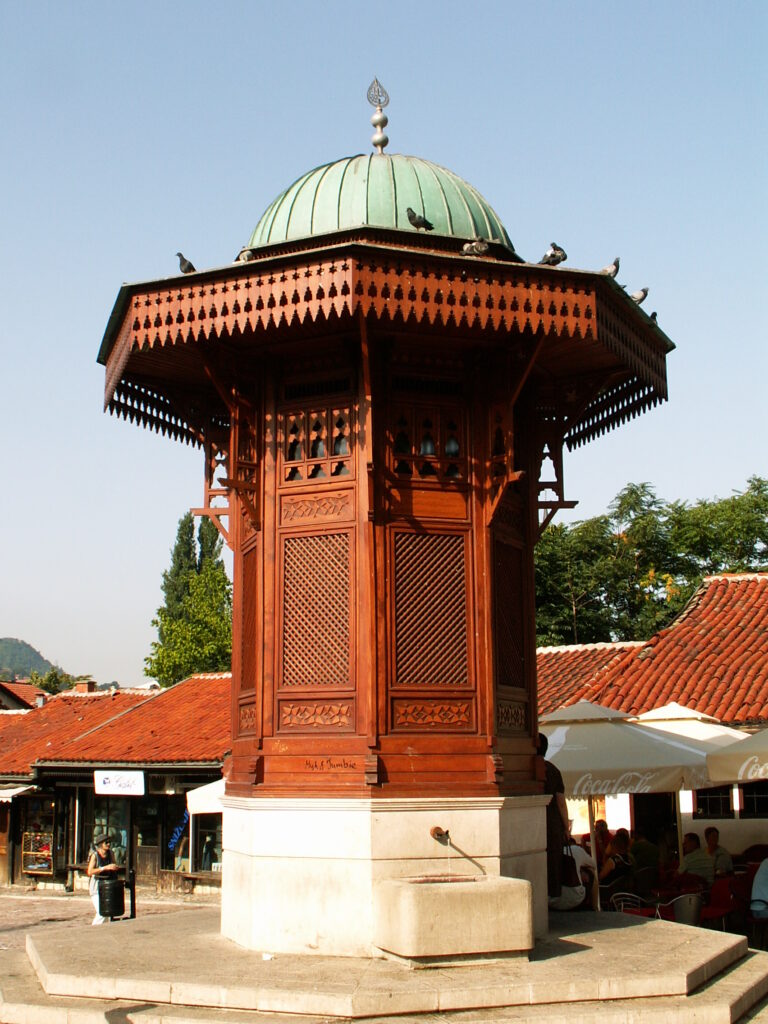
Most walks begin at Sebilj, the wooden fountain standing in Baščaršija Square. Built in 1891 in a Moorish Revival style, it is Sarajevo’s best-known meeting point and an unmistakable symbol of the city. The square can be busy, but it remains worth pausing here to understand the scale of the old bazaar.
From Sebilj, lanes branch into a maze of shops, eateries and workshops. The best approach is not to chase every sight. Let the streets reveal their original purpose: trade, craft, worship and hospitality were closely linked in an Ottoman town.
Kazandžiluk and Sarajevo’s copper craft
Kazandžiluk is the coppersmiths’ lane, where hand-worked copperware continues a long guild tradition. In the Ottoman period, specialist crafts shaped the identity of individual streets. Here, hammered coffee sets, trays and decorative vessels offer a visible connection to that past.
Some pieces are made for visitors, yet the craft itself is real and enduring. Watch for the fine repeated marks left by hand tools. A small copper džezva, the long-handled pot used for Bosnian coffee, makes a more meaningful memento than a generic souvenir.
Gazi Husrev-beg Mosque and its endowments
The Gazi Husrev-beg Mosque is the defining monument of Baščaršija. Completed in 1531, it was built as part of a major civic and religious complex funded by Gazi Husrev-beg, the Ottoman governor who helped shape Sarajevo into an important urban centre.
Its design belongs to the refined Ottoman architectural tradition associated with the school of the great architect Sinan. Yet its importance goes beyond the prayer hall. The mosque’s courtyard, fountain and surrounding endowment buildings show how faith, education, welfare and trade operated together.
Visitors should remember that this is an active place of worship. Dress respectfully, keep voices low, and be mindful that access may be limited during prayer times. Even from the courtyard, the mosque gives a strong sense of Sarajevo’s Ottoman identity.
Covered markets, learning and caravan trade
Near the mosque, the Bezistan provides another view of the old commercial city. This covered market was part of the Gazi Husrev-beg endowment, designed to protect valuable goods and support the wider charitable complex. Its enclosed form feels distinct from the open, winding streets outside.
Nearby stands the Gazi Husrev-beg Hanikah, once connected with religious learning and spiritual life. Together, these buildings reveal that Baščaršija was never simply a shopping district. It was a working urban system sustained by endowments.
Morića Han, an old caravanserai, adds another layer to this story. Such inns gave merchants and travellers a secure place to rest while their animals and goods were accommodated nearby. Sarajevo stood on routes that linked inland Bosnia with the wider Ottoman world.
A half-day heritage walk through the old centre
A rewarding route begins at Sebilj and moves through Baščaršija before following the river east and then turning back towards Ferhadija. The distances are short, but the historical shifts are substantial.
- Sebilj: Take in the square and orient yourself within the bazaar.
- Kazandžiluk: Walk the coppersmiths’ lane and notice the surviving craft tradition.
- Gazi Husrev-beg Mosque: Visit the courtyard and explore the surrounding endowment buildings.
- Brusa Bezistan: See a 16th-century covered market associated with the same endowment tradition. It now houses displays of the Museum of Sarajevo.
- Sarajevo City Hall: Continue towards the river for a sharp change in scale and style.
- Latin Bridge: Walk west along the Miljacka to one of Sarajevo’s most historically charged crossings.
Vijećnica: Sarajevo under Austro-Hungarian rule
Sarajevo City Hall, known as Vijećnica, stands close to the eastern edge of Baščaršija. Opened in 1896, its elaborate Moorish Revival façade reflects the visual ambitions of Austro-Hungarian administration in Bosnia and Herzegovina.
The building later became associated with the National and University Library, making it an important cultural landmark as well as an architectural one. Its position beside the Ottoman-era bazaar is revealing: Sarajevo did not replace one historical identity with another. Instead, new eras were built beside the old ones.
Latin Bridge and the events of 1914
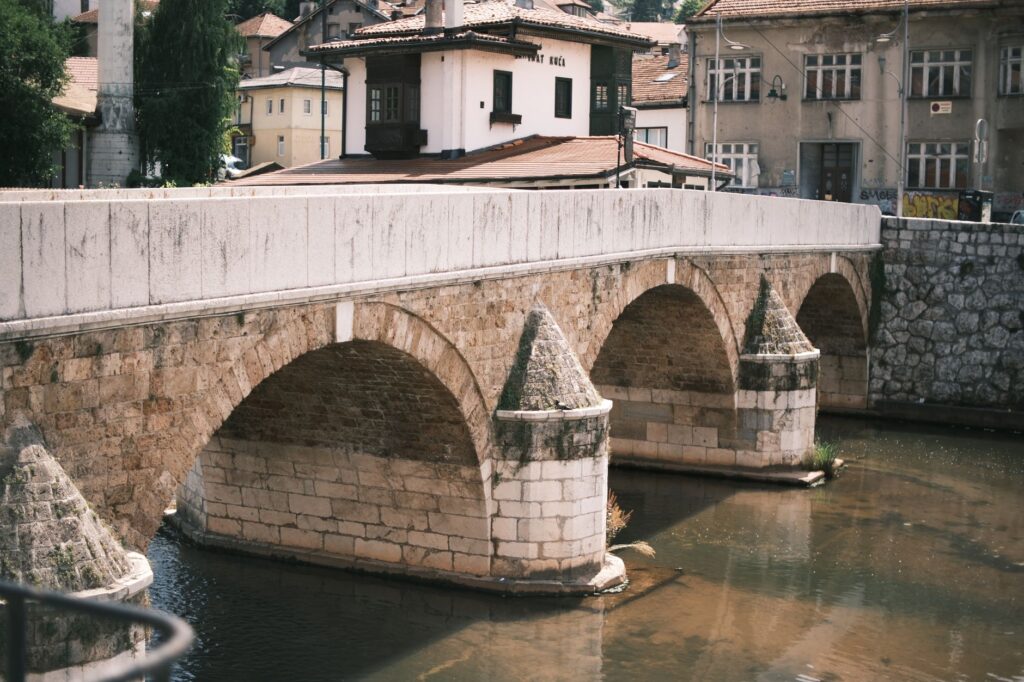
Latin Bridge is a modest stone crossing over the Miljacka, but it carries global historical weight. In 1914, Archduke Franz Ferdinand of Austria and his wife, Sophie, were assassinated nearby by Gavrilo Princip. The assassination took place on the street beside the bridge, not on the bridge itself.
The event helped trigger the chain of diplomatic and military decisions that led to the First World War. Still, it is important not to treat Sarajevo as a mere backdrop to European history. The city had its own deep social, cultural and political life long before 1914.
Faiths within walking distance
Sarajevo’s reputation for religious diversity becomes clear on foot. The Gazi Husrev-beg Mosque anchors the Islamic heritage of Baščaršija, while Ferhadija leads towards prominent Christian landmarks from the later Habsburg period.
The Cathedral of the Nativity of the Theotokos, a 19th-century Serbian Orthodox cathedral, stands near Ferhadija. Its presence reflects Sarajevo’s historic Orthodox community and adds another dimension to the city’s sacred landscape.
Further along Ferhadija, the Sacred Heart Cathedral marks the Catholic presence in Sarajevo. Consecrated in 1889, its Neo-Gothic design contrasts with the Ottoman forms of Baščaršija. That contrast is central to the pleasure of walking this part of town.
The Jewish Museum of Bosnia and Herzegovina is also worth considering for travellers who want a fuller picture of Sarajevo’s Jewish heritage. It offers another perspective on a city shaped by several long-established communities, not by a simple meeting of two cultures.
What to eat in Sarajevo Old Town
Food in Baščaršija is part of its cultural rhythm. The aim is not to find a single “best” restaurant, but to try dishes in the environment where they have long been enjoyed: close to the market streets, over unhurried conversation.
Ćevapi, burek and Bosnian coffee
Ćevapi are small grilled minced-meat sausages, usually served in soft somun bread with chopped onion. They are straightforward, filling and closely associated with Sarajevo. Local preferences can be strong, so treat the experience as a personal discovery rather than a competition between addresses.
Burek is a baked filo pastry traditionally filled with meat. Other fillings, such as cheese, spinach or potato, are popular too, though Bosnians often use different names for those varieties. It is an excellent choice for a casual lunch or a substantial snack.
Bosnian coffee deserves time. It is prepared and served in a džezva, often with a small cup and a piece of sugar or something sweet. It resembles Turkish coffee, but it has its own local customs and social meaning. Drink it slowly rather than treating it as a quick caffeine stop.
Finish with baklava, the syrupy layered pastry found across former Ottoman lands. In Sarajevo, it fits naturally into the bazaar experience, especially after coffee. The details vary from one kitchen to another, which is part of the appeal.
1914, the siege and responsible historical context
Latin Bridge explains one famous turning point, but Sarajevo’s 20th-century story cannot be reduced to 1914. During the 1992–95 siege, the city endured extreme violence, deprivation and loss. This history remains personal for many residents and families.
When you encounter Sarajevo Roses—mortar scars in pavement filled with red resin—treat them as memorials, not as photo props. They mark places where civilians were killed or wounded by shelling. The most respectful response is quiet attention.
Vijećnica also carries a powerful connection to the war years because of the destruction of its library collections. Its restored presence is therefore not just visual. It speaks to cultural loss, resilience and the importance of memory.
Sarajevo Old Town rewards curiosity, but it asks for sensitivity too. Walk its lanes for the architecture and food, then look beyond the postcard scenes. Baščaršija becomes far more meaningful when you see it as a living quarter shaped by trade, faith, empire, conflict and the everyday life of Sarajevo.
Tours & experiences for Sarajevo
Hand-picked experiences with live pricing and traveler ratings.
 Free cancellation
Sarajevo: Mostar, Blagaj, Pocitelj, Waterfall, Konjic with fees
 Free cancellation
Fall of Yugoslavia, Sarajevo War Tour with Tunnel of Hope Museum and Frontlines
 Free cancellation
Sarajevo: Mostar, Konjic, Blagaj, Pocitelj, Kravica fall & Brunch
 Free cancellation
Mostar & Herzegovina 4 Cities Day-tour from Sarajevo (fees incl.)
 Free cancellation
ROSES OF SARAJEVO (Official War + City tour) -Story of a Survivor
 Free cancellation
Sarajevo to Belgrade Private Transfer
ToursToBalkans may earn a commission when you book through our partner links.
Best places in Sarajevo
Selected attractions and places to eat with Tripadvisor data, curated for a cleaner trip-planning experience.
Top attractions in Sarajevo


Recommended hotels in Sarajevo
A smaller selection of better-rated hotels with established review history and Agoda booking links.
 8.8
8.8
Residence Inn by Marriott Sarajevo
Experience an abundance of unparalleled facilities and features at Residence Inn by Marriott Sarajevo.Car hire offeri…
 9.0
9.0
Courtyard by Marriott Sarajevo
Experience an abundance of unparalleled facilities and features at Courtyard by Marriott Sarajevo.Experience the wond…
 8.5
8.5
 8.4
8.4
Selection favors established hotels with stronger ratings, review volume and usable imagery. Final rates and availability are shown by Agoda.