
Kalemegdan Fortress in Belgrade: Gates, Viewpoints and a Self-Guided Walk
Follow a rewarding walk through Belgrade Fortress, from Ottoman gates and ramparts to Victor Monument and the Sava–Danube confluence.
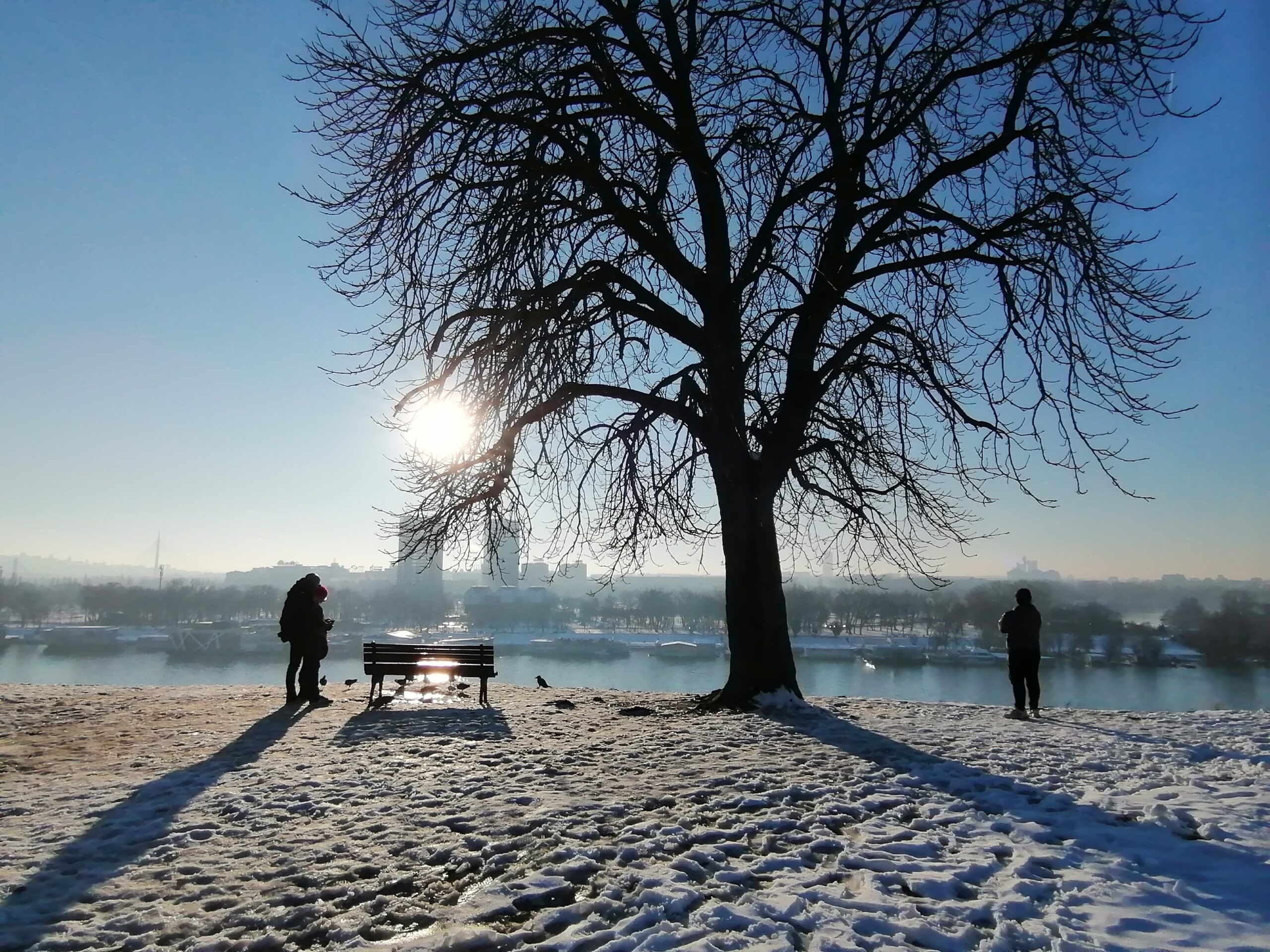
A Kalemegdan Fortress self-guided walk is one of the best ways to understand Belgrade. This vast hilltop complex joins a historic citadel with a leafy public park, dramatic defensive walls and sweeping river views. It also sits at the natural end of Knez Mihailova Street, making it easy to include in a first exploration of the city.
The experience is more than a quick photo stop. Belgrade Fortress reveals why the city has been contested for centuries: it occupies the high ground above the meeting point of the Sava and Danube. Roman, medieval Serbian, Ottoman and Habsburg periods all left their mark on the site. The result is not a single palace or monument, but a layered landscape best discovered on foot.
Continue planning with Belgrade Fortress Kalemegdan: Visitor Guide and Best Things to Do in Belgrade.
Understand the layout before you walk
Kalemegdan is the name commonly used for both the park and the wider fortress area. The word comes from Turkish, combining terms for “fortress” and “battlefield.” Today, the park softens the military setting with mature trees, open lawns, pathways and monuments. Yet the ramparts are never far away.
The site divides broadly into the Upper Town and Lower Town. Upper Town occupies the highest ground and holds many of the major gates, terraces and military landmarks. Lower Town drops down the slope toward the rivers. It feels quieter, more enclosed and more atmospheric, with old walls, religious sites and a stronger sense of the fortress’s hidden edges.
The outdoor grounds are generally easy to wander without treating the visit as a formal museum tour. However, certain interiors operate separately. The Military Museum and the Roman Well are best regarded as optional stops rather than essential parts of the route.
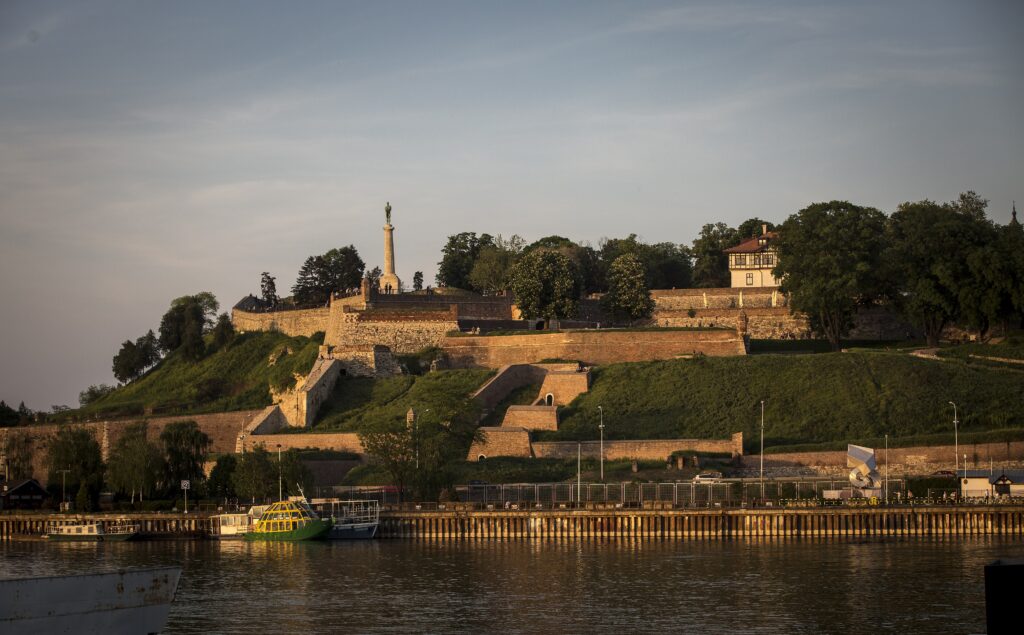
Your self-guided route through Kalemegdan
This walk follows a logical descent from central Belgrade through Upper Town and into Lower Town. Allow time to pause at the viewpoints. The distance is modest, but the terrain includes slopes, steps and uneven stone paths.
1. Enter through Stambol Gate
Approach from Republic Square along Knez Mihailova Street, Belgrade’s principal pedestrian promenade. At its far end, the city opens into Kalemegdan Park and the fortress approaches. Stambol Gate is a fitting first landmark.
This Ottoman-period entrance was once the main route into the fortified Upper Town. Its name refers to the historic road toward Istanbul, then known as Constantinople. Passing through it creates an immediate shift in atmosphere: the shops and cafés of central Belgrade give way to massive stone walls and broad green spaces.
Look around before moving on. This section shows how the fortress worked as a defensive system rather than a stand-alone building. Gateways controlled access, while surrounding earthworks and stone ramparts created several layers of protection.
2. Find Sahat Kula and the Upper Town walls
Near Stambol Gate stands Sahat Kula, the clock tower. It is a useful marker when navigating the Upper Town and a subtle reminder of the Ottoman imprint on Belgrade. The tower is not the fortress’s grandest sight, but it helps place the site within the city’s changing imperial history.
From here, follow the paths along the upper ramparts. The views appear in stages through the trees and across the walls. Take time to notice the contrast between older stonework and later defensive additions. Belgrade Fortress was rebuilt, adapted and strengthened repeatedly, especially as military technology changed.
The Romans established a military settlement here, known as Singidunum. Centuries later, Serbian rulers, Ottoman forces and Habsburg armies reshaped the position. You do not need to identify every wall by era to appreciate the point: this was one of southeastern Europe’s most strategically important riverfront strongholds.
3. Pause at the Military Museum
The Military Museum sits prominently within the fortress area, with artillery pieces, armored vehicles and other military objects displayed outside. These exhibits give the ramparts a more tangible context. They show that the fortress remained connected to warfare long after medieval towers ceased to define military power.
The outdoor displays are easy to see as you pass. An indoor visit can add more detail on Serbian military history, but it is not necessary for a satisfying fortress walk. If your main interest is scenery and architecture, continue toward the river-facing terraces.
4. Reach Victor Monument and Pobednik Plateau
The route’s defining stop is Victor Monument, known locally as Pobednik. Created by sculptor Ivan Meštrović, the bronze male figure stands high above the confluence, facing outward over the rivers. It commemorates Serbian victories in the Balkan Wars and the First World War.
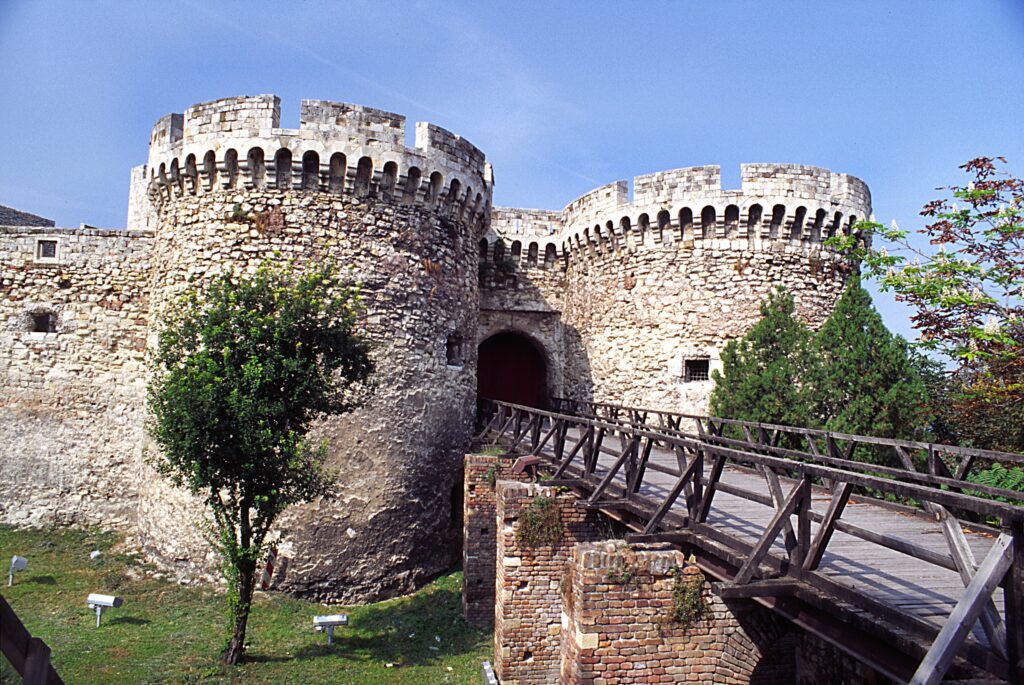
The monument stands on Pobednik Plateau, a broad terrace at the fortress edge. This is the place to orient yourself. Below, the Sava flows in from the west and meets the Danube, which continues eastward. Across the water lies New Belgrade, whose modern blocks form a sharp contrast with the old citadel.
The panorama explains Belgrade’s history in a single glance. Control this hill, and you could watch movement on two great waterways and the surrounding plains. It is also simply one of the city’s most memorable viewpoints, especially when the lower light gives the rivers and distant skyline more definition.
Why the confluence viewpoint matters
Many cities have a signature skyline view. Belgrade’s most meaningful panorama is more geographical than architectural. From the fortress terraces, you see the meeting of the Sava and Danube, the broad northern horizon and the relationship between historic Belgrade and newer districts across the water.
Victor Monument is the most recognisable focal point, but do not rush away after taking a photograph. Walk along the nearby paths and look from different angles. Some views frame the rivers through foliage, while others open wide across the embankments and New Belgrade.
This is also where Kalemegdan Park works especially well. The park gives the fortress room to breathe. Benches, tree-lined paths and open areas let you take in the defensive setting without feeling trapped inside a museum complex.
Descend to Lower Town through Zindan Gate
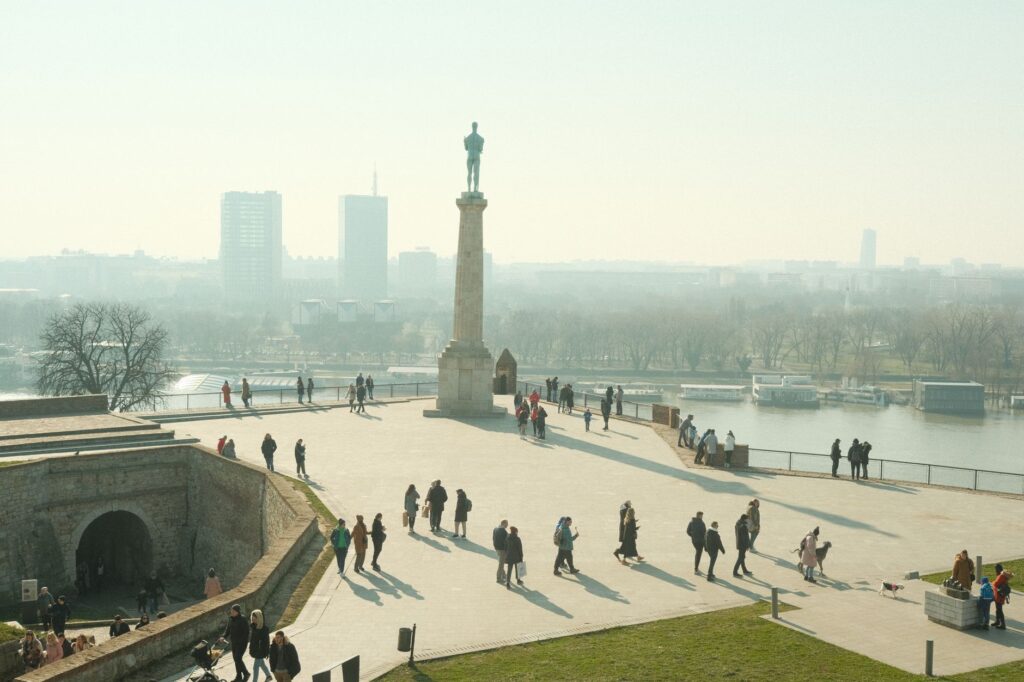
5. Walk toward Zindan Gate
From Upper Town, make your way toward Zindan Gate, one of the fortress’s most striking entrances. Its two heavy towers and deep-set passage make it easy to picture the fortification under pressure. The name “zindan” is associated with a dungeon, reflecting the gate’s former role in the fortress system.
Zindan Gate has a more medieval character than the broad Upper Town terraces. It feels built for defence, not display. Stand back to appreciate the thickness of the walls and the controlled, narrow approach. This is one of the clearest examples of how architecture could slow and expose anyone attempting to enter the citadel.
The descent from this area can involve steps and irregular surfaces. Wear comfortable shoes and take your time, especially after rain. The rougher terrain is part of Lower Town’s appeal, but it is less straightforward than the main paths around the plateau.
6. Visit Ružica Church and the Chapel of Saint Petka
Lower Town offers a quieter counterpoint to the exposed ramparts. Ružica Church sits close to the fortress walls and has a modest, intimate character. The church has a wartime history and was rebuilt after damage during the First World War, adding another human layer to this military landscape.
Nearby, the Chapel of Saint Petka is an important Orthodox site associated with a spring. Even if you are not visiting for religious reasons, the area offers a peaceful pause from the wider park. It also shows that Belgrade Fortress has long been more than a battlefield. It has been a place of worship, daily life and memory.
After visiting the churches, look back uphill. From Lower Town, the scale of the walls becomes more apparent. The fortress no longer feels like a scenic park; it feels like the formidable structure it once was.
Optional detours for history-minded visitors
The Roman Well
The Roman Well is one of the fortress’s most intriguing features, though its name is misleading. It is not Roman in origin. The structure dates from the eighteenth century, when the Habsburgs developed parts of the fortress.
Its deep circular shaft has inspired many stories, but the real interest lies in the engineering. It was designed to secure a water supply within the fortifications. Conditions for entering the well can vary, so regard it as an extra stop if access is available during your visit.
Despot Stefan Gate
If you have time to explore the northern side of the Upper Town, seek out Despot Stefan Gate. It is not essential for a first route, but it adds another perspective on the fortress’s medieval defences. The gate is named after Despot Stefan Lazarević, a major Serbian ruler connected with Belgrade’s medieval development.
This detour is worthwhile for visitors who enjoy walls, gateways and the small details of historic urban fortifications. Otherwise, the main route already captures the fortress’s strongest visual and historical moments.
How to finish the walk
After Lower Town, you can return uphill through the park or follow paths back toward the Upper Town. Ending near Stambol Gate places you close to Knez Mihailova Street again, so it is easy to continue toward Republic Square and central Belgrade.
For a shorter visit, focus on Stambol Gate, the Military Museum exterior, Victor Monument and Pobednik Plateau. For a fuller experience, continue through Zindan Gate to Ružica Church and the Chapel of Saint Petka. The complete circuit gives you the best sense of the fortress’s vertical layout, from its commanding heights to its protected riverside edges.
Kalemegdan rewards curiosity more than speed. Its greatest appeal lies in the way each gate, terrace and wall contributes to a larger story. By the end of the walk, the rivers below and the city behind you make Belgrade’s strategic past feel immediate rather than distant.
Tours & experiences for Belgrade
Popular experiences with current pricing and traveler ratings.
 Free cancellation
Northern Serbia: Sremski Karlovci and Novi Sad Full-Day Tour from Belgrade
 Free cancellation
From Belgrade: Novi Sad and Sremski Karlovci Tour
 Free cancellation
Belgrade Underground Tour w/ Sparkling Wine Along the River
 Free cancellation
Belgrade Old Town Walking Tour with a Guide
 Free cancellation
Day Trip from Belgrade: Gems of Eastern Serbia
 Free cancellation
Private Walking Tour of Belgrade and Old Zemun
ToursToBalkans may earn a commission when you book through our partner links.