
Trogir Old Town Walking Route: What to See Beyond the Main Gate
Follow a rewarding Trogir walk from the Land Gate to the waterfront, taking in Romanesque carvings, Venetian defenses and harbor views.
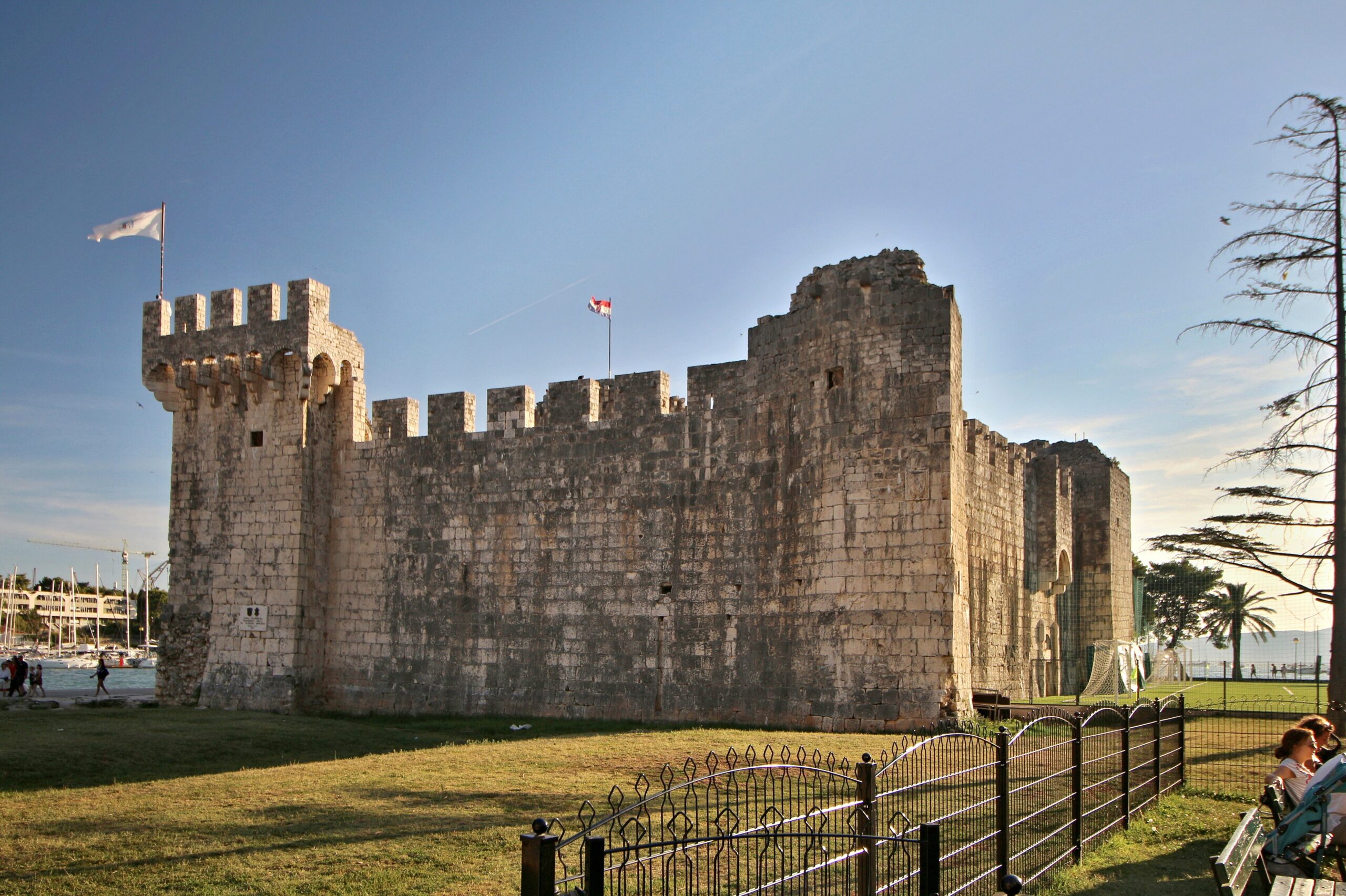
A Trogir Old Town walking route is one of the best ways to understand this small, richly layered Croatian town. The UNESCO-listed historic core sits on a compact island between the mainland and Čiovo. Its narrow lanes lead from a Venetian gate to a great Romanesque-Gothic cathedral, civic squares, a waterfront fortress and the palm-lined Riva.
This route follows a simple north-to-south line. Allow around two hours for the principal sights, or up to four if you visit the cathedral, climb its bell tower and wander without rushing. Trogir is not a place to race through. Its appeal lies in looking closely at carved stone, shaded passages and changing views of the harbor.
Continue planning with Croatia.
The route at a glance
Enter the old town through the North Gate, also known as the Land Gate. From there, walk through the medieval lanes to the Cathedral of St Lawrence and the square beside it. Spend time with Radovan’s Portal, the Town Loggia, Clock Tower and the façades around the square.
Continue south and let the quieter streets guide you toward the waterfront. Kamerlengo Castle marks the southern end of the island, while the Riva offers the natural finale: boats in the harbor, views across to Čiovo and a welcome place to sit.
- North Gate: Venetian defenses and Trogir’s patron saint.
- Cathedral of St Lawrence: the old town’s defining monument.
- Radovan’s Portal: exceptional 13th-century stone carving.
- Town Loggia and Clock Tower: Trogir’s historic civic heart.
- Kamerlengo Castle: a Venetian fortress above the harbor.
- Trogir Riva: the waterfront promenade and island views.
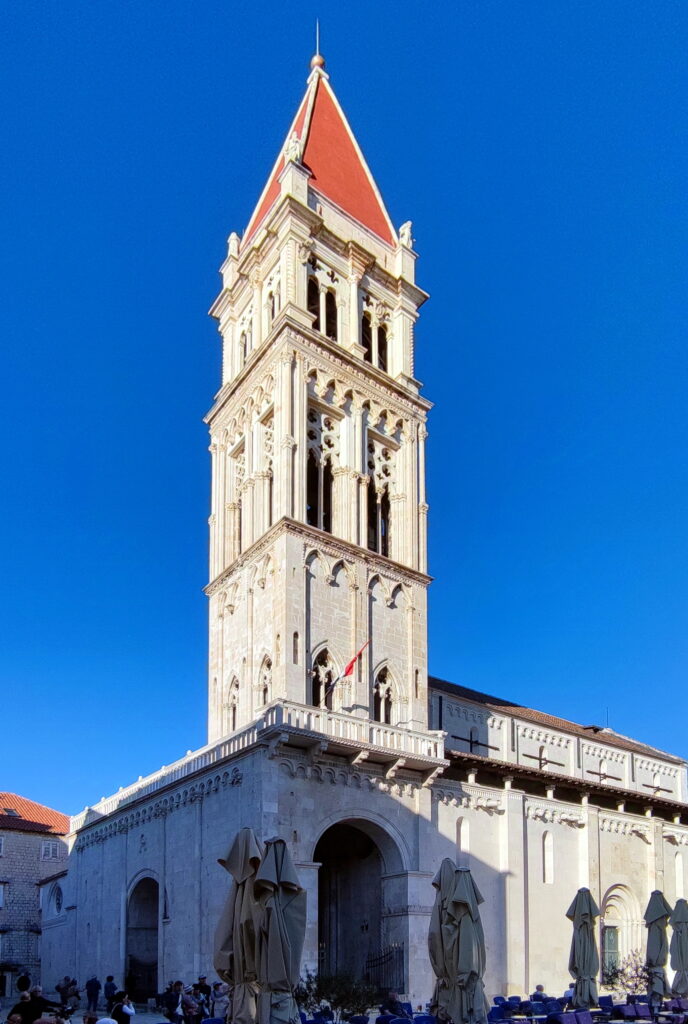
Enter through the Land Gate
The North Gate is the most satisfying entrance to Trogir’s historic island. Built in the 15th century, it formed part of the town’s Venetian-era defenses. Passing beneath it creates a clear transition from the modern approach into a world of limestone lanes and close-set medieval buildings.
Look up before you go through. The gate carries a relief of St John of Trogir, the town’s patron saint. It is an important first clue to how civic pride, religious devotion and defensive architecture overlap in Trogir.
Beyond the gate, avoid trying to follow every alley with purpose. The old town is small enough to explore intuitively. Let yourself make a few short detours, especially where a lane opens unexpectedly onto a tiny square, a carved doorway or a glimpse of the water.
The cathedral and Radovan’s Portal
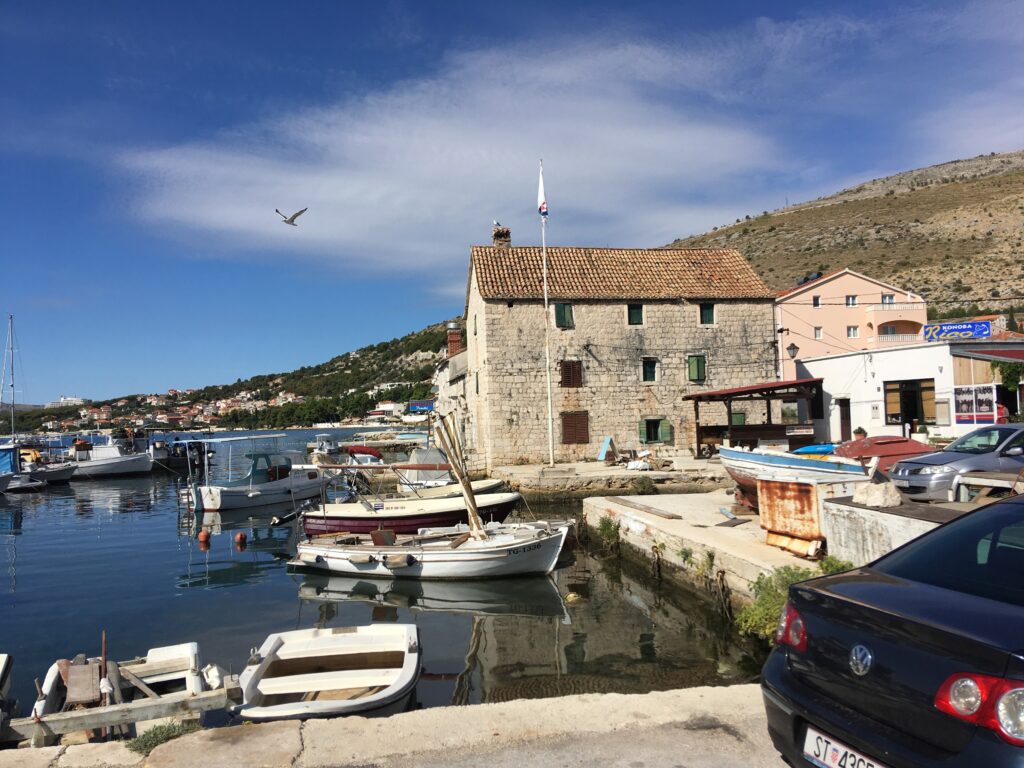
The Cathedral of St Lawrence is the essential stop on any walk through Trogir. Construction extended across centuries, and the building reveals that long history in its Romanesque foundations, Gothic elements and later additions. Even visitors with little interest in church architecture tend to pause here.
Give Radovan’s Portal proper attention
The cathedral’s west portal, completed in 1240 by Master Radovan, is one of the great works of medieval sculpture on the Adriatic coast. It deserves more than a quick photograph. Stand back first to take in its full composition, then move closer to notice its crowded scenes.
Adam and Eve stand prominently beside the entrance, while biblical episodes unfold through the carvings. You can also spot imagery drawn from daily life and the cycle of the seasons. That mix makes the portal feel unusually human. It speaks not only of scripture, but also of the medieval world that shaped it.
The detail is remarkable because it rewards different ways of looking. From a distance, the portal frames the cathedral entrance with confidence. At close range, it becomes a dense visual story in stone.
An optional climb for a wider view
The cathedral’s bell tower rises above the surrounding roofs and offers a stronger sense of Trogir’s island setting for those able to climb it. From above, the old town’s tight plan becomes clear: the mainland lies to one side, Čiovo to the other, and the harbor curves around the southern edge.
Access arrangements can change, so check locally if the tower is an important part of your visit. It is a worthwhile add-on, but the walking route remains complete without it.
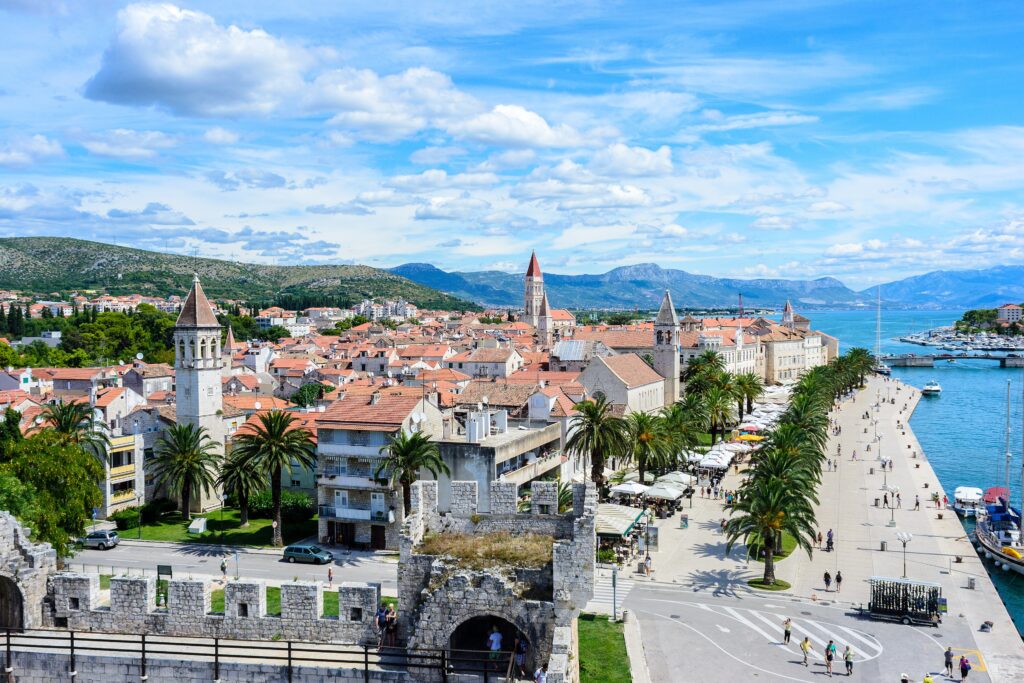
The square: civic Trogir beside sacred Trogir
The space around the cathedral, often known as John the Baptist Square, holds several of Trogir’s most important buildings within a few steps. This is where the route slows down. Rather than moving immediately onward, walk around the square and compare the different façades.
Town Loggia and Clock Tower
The 15th-century Town Loggia once served as a public civic space, where official announcements and legal matters could be conducted. Its open arches make it feel less like a sealed monument and more like part of the square’s everyday life.
Inside, look for the Justice relief by Nikola Firentinac. It is a fine Renaissance detail in a place built for public authority. Beside the loggia, the Clock Tower adds another vertical landmark to the cathedral complex and helps give the square its distinctive skyline.
Cipiko Palace and St Peter’s Church
Opposite the cathedral, Cipiko Palace is easy to admire even from the street. The residence belonged to the influential Cipiko family, and its Gothic-Renaissance details show how wealthy families shaped Trogir’s built environment. Look at the windows, stonework and small decorative features rather than seeking one grand viewpoint.
Nearby, St Peter’s Church is a compact stop beside the loggia. Its size makes it easy to overlook, yet its Renaissance sculpture adds another layer to this concentrated corner of town. Together, the cathedral, civic buildings, palace and church make the square feel like a condensed history of Trogir.
Through the lanes to Kamerlengo Castle
Leave the cathedral area by heading south toward the harbor. This is the best stretch for unplanned lane wandering. The streets are narrow, often cool in shade, and lined with stone houses that reveal fragments of Trogir’s long urban history.
There is no need to force a strict sequence here. Keep the waterfront in mind and follow the passages that draw you onward. The town’s scale means you are unlikely to stray far from the route.
A small French-era marker
Near the fortress, Marmont’s Monument offers a brief reminder that Trogir’s story did not end with Venice. This small memorial relates to the Napoleonic era, when the region fell under French administration. It is not a major destination, but it adds context before you reach the much older defenses.
Kamerlengo Castle and the harbor wall
Kamerlengo Castle occupies a commanding position on Trogir’s southern waterfront. The Venetians built this 15th-century fortress to strengthen control of the harbor and the town. Its thick walls feel direct and functional, especially after the elaborate carvings around the cathedral.
Walk around the exterior to appreciate how the castle faces the water. The harbor-facing walls explain its purpose better than any plaque can. If the courtyard is accessible during your visit, it offers another perspective on the fortress’s scale and enclosed defensive form.
St Mark’s Tower stands nearby and contributes to the same fortified waterfront character. It is worth noticing as you move along the edge of the old town, even if you choose not to make it a separate stop.
Finish on the Trogir Riva
The Trogir Riva runs along the waterfront below the castle and provides the gentlest ending to the walk. Palm trees, cafés and boats soften the medieval stone setting. After the confined lanes, the open harbor feels especially spacious.
Find a place to pause and look toward Čiovo. The view helps explain Trogir’s geography: the old town occupies its own small island, with the mainland behind you and Čiovo immediately across the water.
The bridge to Čiovo is a natural short extension if you want a different angle on the old town. Even viewing it from the Riva is enough to understand the close relationship between Trogir’s historic island, its harbor and the larger island beyond.
Timing, comfort and old-town etiquette
This is best treated as a half-day experience, not a full-day checklist. Two hours suits visitors who want to see the main monuments and enjoy the waterfront. Add time for the cathedral interior, bell tower, photography or an unhurried break on the Riva.
Early morning and later afternoon often bring softer light on the pale stone and a more reflective atmosphere in the lanes. The route is compact, but uneven stone surfaces deserve sensible footwear. They can become slippery when wet.
Dress respectfully if you plan to enter active churches, particularly the Cathedral of St Lawrence. Above all, keep your pace flexible. Trogir’s famous landmarks matter, but the route becomes memorable in the moments between them: a quiet alley, a weathered coat of arms, or the sudden sight of the sea at the end of a lane.
Tours & experiences for Trogir
Hand-picked experiences with live pricing and traveler ratings.
 Free cancellation
Blue Cave and Hvar Tour - 5 Islands Tour from Split and Trogir
 Free cancellation
Blue Cave, Mamma Mia and Hvar, 5 Islands Speed boat Small group
 Free cancellation
From Trogir & Split: Half Day Speedboat Tour with Blue Lagoon
 Free cancellation
Hvar, Brač & Pakleni islands cruise with lunch & drinks from Split & Trogir
 Free cancellation
Private Boat Tour by local expert - Create Your Itinerary
 Free cancellation
Krka Waterfalls Day Tour with Boat Ride from Split and Trogir
ToursToBalkans may earn a commission when you book through our partner links.
Recommended hotels in Trogir
A smaller selection of better-rated hotels with established review history and Agoda booking links.


Selection favors established hotels with stronger ratings, review volume and usable imagery. Final rates and availability are shown by Agoda.